
By John Schneidawind, vice president of public affairs, ARTBA
Imagine if highway workers and the motorists approaching them could automatically alert each other to avoid close and potentially dangerous contact.
That’s the promise of ‘cellular vehicle-to-everything’ technology, or C-V2X, which uses a slice of the 5.9GHz radio spectrum for nearly instantaneous direct communications between vehicles, roadside infrastructure equipment, and workers wearing special protective vests. Through advance warning of each other’s location, C-V2X can potentially reduce traffic and roadway worker deaths and injuries on the nation’s highways.
Such services have ‘enormous potential,’ said Brad Stertz, government affairs director at Audi of America, one of the private firms and public agencies involved in a year-long test of the technology. ‘It has great value in taking the hazards out of roadwork.’
Other partners included the Virginia Department of Transportation (VDOT), the Virginia Tech Transportation Institute (VTTI), American Tower, Commsignia, Qualcomm Technologies, and Traffic Technology Services.
More than 20,000 people died in motor vehicle crashes on U.S. roads during the first six months of this year, a nearly 20 percent increase from the same period in 2020, according to the National Highway Traffic Safety Administration (NHTSA). The agency reported 135 roadside worker fatalities – in addition to 39,000 injuries and 115,000 vehicle crashes in work zones – in 2019.
Testing applications
Testing took place on Interstates 66 and 495, and U.S. 29 and 50, in northern Virginia, some of the most congested highway corridors in the country. VTTI Division of Technology Implementation Director Mike Mollenhauer said the trial explored how well C-V2X works in two applications: in work zones and where road users face upcoming highway hazards; and with traffic signals that might notify drivers when they are about to drive through a red light.
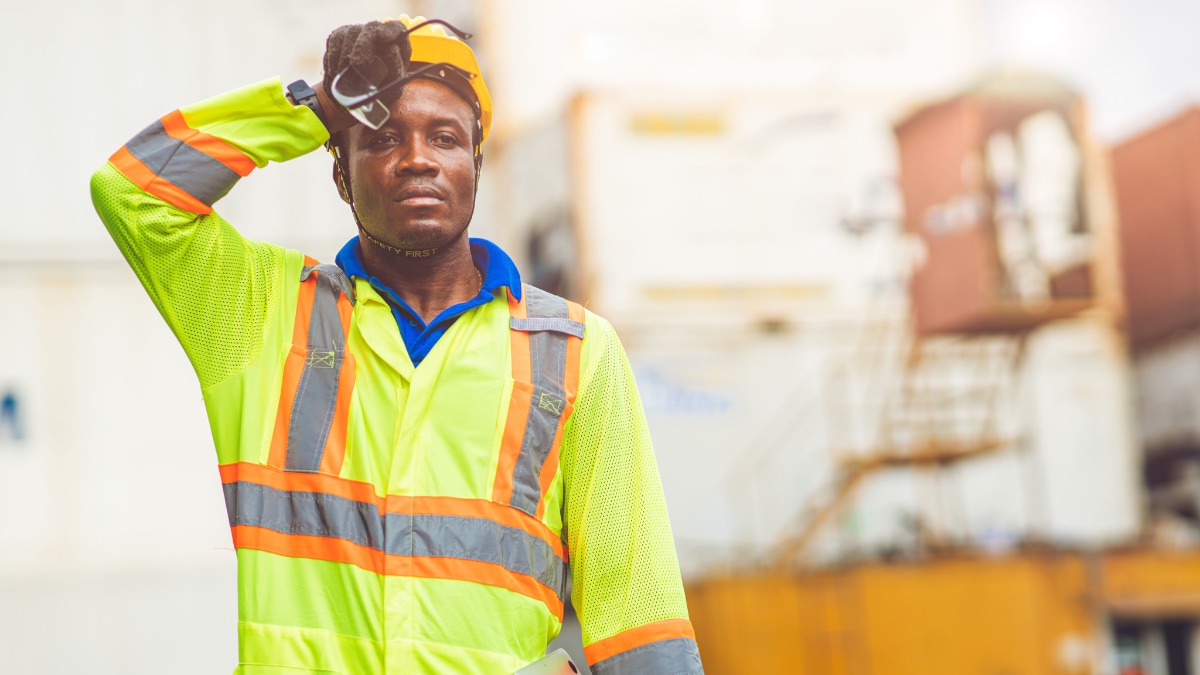
In the first scenario, the trial featured roadside workers wearing vests equipped with C-V2X receivers. Qualcomm equipped Audi Q8 test vehicles with dashboard technology that delivered warnings and alerts to drivers and roadside workers about each other’s presence. The alerts appear in the Audi vehicle’s instrument panel behind the steering wheel. Workers wearing the vests heard a loud and constant beeping sound as the special gear also illuminated.
The technology functions like a portable outdoor Wi-Fi, with suitcase-sized base stations placed along the roadway about every 1,300 feet. The units provided a connection between cars and between cars and the vests worn by roadway workers. If a car veered too close to a construction site, its dashboard would light up with a warning. And the roadside workers’ vests would signal its wearers that a vehicle was too close, allowing them to avoid it.
The trial also tested red light violation warning technology using a feature already available to Audi customers at more than 22,500 intersections nationwide. Using the C-V2X spectrum, the technology tested a vehicle’s ability to sense if and when it would need to slow down to avoid having to stop at a red light or potentially running a red light that had changed. In the future, the system can be further honed to prevent vehicles moving through an intersection from colliding with one another, Mollenhauer said.
Other applications
The C-V2X spectrum holds promise in a host of other applications, Audi says. In Alpharetta, Ga., the technology yielded promise in safeguarding children in school zones getting on and off school buses by notifying drivers of an upcoming stop. C-V2X can also be used to let drivers know when they get too close to crowded bicycle lanes.
For now, the priority is driver and highway worker safety.
Audi estimates 5.3 million vehicles, work zones, railway crossings, bicycles, and other devices will be able to connect to C-V2X frequencies by 2023. By 2028, that number could increase to 61 million connected devices, including as many as 20,000 crosswalks, 60,000 school zones, 216,000 school buses, and 45 million smartphones. The car maker says it plans to work with partners to develop additional use cases next year leading up to production applications.
Topic
Safety
Post Type
Newsline Article
Related News

Change to Inspection Guidance for Heat Hazards
What happened: OSHA April 10 updated its National Emphasis Program (NEP) on outdoor and…
Missouri Teens Want Others to Know What’s at Stake in Work Zones
What’s happening: Teens from 10 Missouri high schools helped kick off a new safety…

Senators Call On OSHA to Drop Heat Rule
What’s happening: Sixteen Republican Senators led by Health, Education, Labor & Pensions Committee Chairman Bill…