
by Beth McGinn, vice president of communications, ARTBA
Imagine sitting at work while hundreds of cars zip past your desk. Now, imagine some of the people behind the wheel are distracted or impaired. This is what America’s roadway workers—also known as vulnerable road users— face every day while on the job.
The work zone is their office, and their safety depends on several factors—the most important being attentive and responsible drivers. Message boards, orange barrels, attenuators and other visual alerts and physical barriers are essential. But are there any emerging technologies that could also keep workers and drivers safe?
This question is always top of mind for Kurt Shea. As the safety director of Michigan-based PK Contracting—a leader in the pavement striping industry and subsidiary of Frontline Road Safety Group (FRSG)—he is constantly on the lookout for new ways to protect his employees and the motoring public.
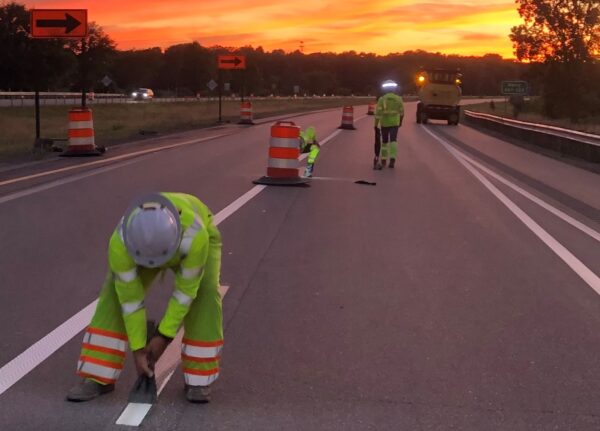
Pavement marking and patch crews have the highest incident of crashes involving motorists. Unlike static work zones, which have fixed, posted signs warning motorists of the hazards ahead, pavement marking crews are mobile convoys. Their trucks are equipped with strobe lights to warn and arrow boards to direct traffic to the open lane. In Michigan, these crews move along the freeway between eight and 20 miles per hour. If drivers are not looking ahead, the large speed differential between workers and oncoming traffic can cause sudden braking and swerving. In some instances, the unthinkable happens. Shea estimates there are between four to seven catastrophic truck-mounted attenuator (TMA) crashes annually in his state.
“You are putting faith and hope in the motorists that they are attentive,” Shea said. “We can throw our hands up in the air and say, ‘it is what it is,’ or we can be innovative and find new technologies.”
The “Ah-Ha” Moment
For Shea, it is personal. His dad started PK in 1976, and his son is one of a growing number of third generation family members to work there.
“Someone asked me during a meeting, ‘What percentage of improvement do you want to see in your safety?’ Our response was ‘we want 100 percent. We want zero incidents. That’s our driving force,’” said Shea. “We are family out there.”
Back in 2018, Kurt was returning from a night job when a light bulb went off. “I was in my Ford vehicle on I-94 at about one in the morning, and I got an alert: ‘crash ahead,’” he recounted. “This kind of woke me up.”
Seconds later he saw the lights of a police vehicle and ambulance on the shoulder. In industry speak, this is known as “advanced notice” for motorists. Instead of the notice coming from outside the car (think arrow boards), the notice was inside the car. A transponder in one of the emergency vehicles sent a message through his car’s navigation system.
PK Contracting is now part of an effort to test these advanced digital warnings in the roadway construction and maintenance industry. Working with the Michigan Department of Transportation and a grant from the Federal Highway Administration, PK pavement marking crews are collecting data that will help build the next iteration of this technology—self-driving cars and connected and automated vehicles (CAVs) that talk to smart work zone technology.
The Future is Now
The application of CAVs is the future, but the use of advanced warning digital alerts is currently growing at a rapid pace. HAAS Alert is a company at the forefront of this innovation. The roadway safety company, based out of Chicago, has been around for almost 10 years. It is already the leader in this space with over 4,000 customers in North America and many more in Australia, New Zealand, the U.K., and Europe. Their product, Safety Cloud®, has become a standard tool for industries such as public safety agencies, departments of transportation (DOTs), construction and utility workers, parcel delivery companies, and even tow truck companies.
Tom Parbs, vice president at HAAS Alert, said, “When you have road workers out there that need to be protected, Safety Cloud® is giving an audible and visual warning 30 seconds upstream. It’s intended to disrupt your phone call, your radio, the coffee you are drinking, or the makeup you’re putting on.” Parbs notes that driving and talking on the phone is the equivalent of driving with a .08 blood alcohol content.
“The motoring public likes to multitask,” he added. “These alerts disrupt the distractions. They make people aware 30 seconds before the traditional advanced warning area of a work zone.”
At faster speeds, these alerts can reach people a half-mile up from the work zone, giving drivers time and space to slow down and move over. Safety Cloud® does this by partnering with other software companies like Waze (a Google-owned company) and Apple Maps, as well as natively with Chrysler Fiat (Stellantis) vehicles, with whom it has a direct partnership.
HAAS Alert can provide crews with digital alerting transponders to place inside their flashing lights vehicles and construction equipment, or their software can synchronize with telematics (GPS) systems crews already have with them, such as Samsara, WebFleet, Geotab, Azuga, and Cradlepoint.
The relationship between Safety Cloud® and its digital partners is mutually beneficial. HAAS Alert is the world’s largest provider of road hazard data to companies like Waze, which traditionally depend on crowdsourced information provided by motorists.
Crowdsourced data is useful, but is not considered a “ground truth,” as it relies on what drivers perceive to encounter. It also may not reflect conditions in real-time. For example, the apps may not know when a disabled vehicle has been moved from the roadway, a police car has moved on to a new location, or road workers have moved to different parts of the highway.
“When we tell Waze or a Stellantis vehicle that you are there, and you need to be protected, there is no question. That is a 100 percent ground truth because we know where workers are every second within three feet of accuracy,” Parbs said.
IIJA Incentivizes Action
Adoption of this digital alerting system by state DOTs has accelerated thanks to the passage of the 2021 Infrastructure Investment and Jobs Act (IIJA). U.S. Senators Dick Durbin (D-Ill.), Tammy Duckworth (D-Ill.), and U.S. Representative Cheri Bustos (D-Ill.) championed the Roadside Responders Act, which was added to the bill providing states with funding to purchase the technology if they write e-digital alerting with National Highway Traffic Safety Administration approval into their state highway plans. According to Parbs, 60 percent of states have done so, with the rest set to follow suit.
Transportation agencies are not the only ones taking notice. Contractors are purchasing access to these tools as well.
“They are buying our product because the safety of their employees comes first, and they want to have the advantage over another company that is bidding for that job who can’t provide the same level of safety that they do,” Parbs said. He noted that the added layer of advanced warning for employees can also help with hiring, retention, and morale. Fewer incidents can also lead to better safety scores and better insurance rates.
Enhancing Safety is An Easy Decision
While there is no data to draw a direct line between e-digital alerts and insurance rates, studies show they do have a dramatic impact on driver behavior. The odds of a crash were up to 90 percent lower when drivers received an advanced digital alert, according to a study published by researchers at the University of Minnesota. A 2021 Purdue University study found that digital alerting helped reduce hard-braking events on the interstate by 80 percent or more.
For Shea and his colleagues within the Frontline Road Safety Group, adding the equipment to their vehicles has been an easy decision.
“My dad started this company from nothing. He got an undersized paint truck, and within a year or two was cutting the tanks to make them larger. That’s American ingenuity and innovation,” Shea said. “As I get older, I want to pass that along and make it better and safer for the next person.”
Above photo: Crews in Michigan stripe pavement inside a mobile work zone. Photo courtesy of PK Contracting, part of Frontline Road Safety Group.
Related News

2025 ARTBA Chair Jeff Nelson: Building from A to Z
by John Schneidawind, ARTBA vice president of public affairs Jeff Nelson, who was…
Celebrating a Century of Excellence: The Legacy of United Infrastructure Group
by Rett Triplett, P.E., UIG vice president of strategic partnerships, and Kaitlyn Triplett,…

A Century of Building the Extraordinary: Celebrating 100 Years of Zachry
by Beth McGinn, vice president of communications, ARTBA This year, San Antonio-based Zachry…