

Remember earlier this year when I predicted the regulatory forecast was cloudy and about to pour? It turns out our Doppler radar was accurate. This spring, we saw a downpour of final rules including the Occupational Safety and Health Administration’s (OSHA) Worker Walkaround rule, Fish and Wildlife’s Endangered Species rules, and the U.S. Department of Transportation’s Disadvantaged Business Enterprise rule.
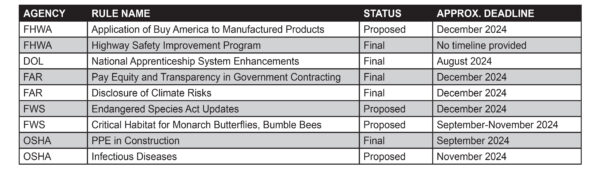
And it looks like the downpour isn’t over yet. With President Joe Biden deciding not to seek a second term, we can expect his administration to prioritize implementing several unfinished policies. Key rules to watch include OSHA’s proposed heat safety standard and the Federal Highway Administration’s rollback of the Buy America waiver for manufactured products. Both will impact jobsites.
While regulators are moving full speed ahead, perhaps the most significant developments have come from the courts. On June 28, the Supreme Court issued a landmark decision overturning the long-standing Chevron doctrine, which allowed agencies to interpret vague laws, so long as their interpretations were “reasonable.” This means courts will no longer defer to the administration’s view of unclear legislation. Practically, we could see less policy flip-flopping every time a new president takes office—think Waters of the United States (WOTUS). Clear, consistent rules make it easier to plan and build transportation infrastructure.
Another impactful decision came in the Cornerpost case, where the Court ruled that people or businesses can challenge a regulation only after experiencing actual harm, not just when the rule goes into place. This decision is important for our sector because the negative impacts of some regulations may not be immediately apparent. It also opens the door for challenges to long-standing regulations if they cause harm down the line, though this is a bit of a double-edged sword. On one hand it may offer mechanisms for challenging onerous rules. On the other hand, if a long-standing policy is challenged, it may create unnecessary uncertainty and confusion.
In the Jarkesy case, the Court decided that the Security and Exchange Commission’s (SEC) use of in-house administrative judges to decide cases violates the right to a jury trial. While this case was specific to the SEC, it could have broader implications for other agencies, like the Department of Labor and the Environmental Protection Agency (EPA), which also use internal judges. This shift could bring more fairness and oversight to the rulemaking process but may also complicate and lengthen the adjudication process. For example, if EPA accuses a business of violating environmental laws, instead of having to go through an internal agency adjudication process, which may raise concerns about impartiality, the business could argue for an impartial jury trial.
In sum, the first half of 2024 has seen significant regulatory actions and judicial decisions that are reshaping the landscape for transportation construction. These changes might bring more stability to regulatory policies but could also introduce new complexities in their implementation. As we navigate the rest of the year, ARTBA will keep you informed and prepared for what’s ahead.
Some Key Rules to Watch
*Deadlines are taken from the recent Unified Regulatory Agenda. This list is not exhaustive.
Related News

2024 Elections: What Could Happen and What It Means For Federal Transportation Policy
by Lauren Schapker, vice president of legislative affairs, ARTBA Ready for change? Then…
Supreme Shift: What the Chevron Ruling Means for Transportation Construction
by Prianka Sharma, vice president & counsel, regulatory affairs, ARTBA Earlier this year,…

The Road Ahead: 2024 Federal Legislative, Regulatory and Political Outlook
by Beth McGinn, vice president of communications, ARTBA Baseball legend Yogi Berra once…