
by Lauren Schapker, vice president of legislative affairs, ARTBA
Ready for change? Then the 2024 election cycle will not disappoint. No matter who wins the White House in November, a new administration will take over in January. And at least 60 new members of the U.S. House and Senate will be sworn in.
Transportation will not be a decisive issue this cycle, but ensuring we elect people who are strong supporters of infrastructure investment remains our top priority. Whether former President Donald Trump or Vice President Kamala Harris takes office, the next president will have significant influence over the agenda and priorities. And the next Congress will be tasked with renewing the surface transportation portions of the Infrastructure Investment and Jobs Act (IIJA) law, which are set to expire in 2026.
The balance of power in Washington will also have implications on what and how things get done. With split-ticket voting in steady decline, those running in the House and Senate have a diminished ability to control their fates. At the same time, the effects of gerrymandering have yielded fewer competitive seats, which means narrow margins between the majority and minority parties are expected to persist.
While control of the White House, House and Senate remains too close to call, the following offers an analysis of where things stand as of August and their possible implication on federal transportation policy.
Race for the White House: The Infrastructure Angle
Former President Trump easily secured the Republican nomination and was favored to be re-elected through early summer. However, President Joe Biden’s decision not to seek re-election reset the presidential race. Democrats quickly coalesced around Vice President Harris, and early polling indicates a more competitive race, with an electoral map centered on the usual group of swing states.
Here’s a look at where the candidates stand:
☑ Harris-Walz Ticket
- Before becoming vice president, Harris was elected to the U.S. Senate in 2016 and served on the Senate Environment and Public Works (EPW) Committee. She left the Senate prior to the vote on the IIJA.
- In her 2020 campaign for president, Harris proposed investing $1 trillion in infrastructure, including $385 billion for roads, bridges, and public transportation.
- As vice president, Harris has appeared at several events touting infrastructure law projects and is on record supporting high-speed rail projects in her home state of California and elsewhere.
- Harris has vowed to continue President Biden’s pledge to not raise taxes on households making under $400,000, which could limit opportunities to raise revenue for the Highway Trust Fund (HTF).
- The Democrats’ 2024 platform highlights the achievements of the infrastructure law throughout, like rebuilding roads, bridges and ports, but does not address forward-looking plans for infrastructure investment.
- Harris’ running mate, Minnesota Governor Tim Walz, has been a vocal supporter of transportation investment. While a member or the House of Representatives, from 2007 until 2019, Walz served much of his time on the Transportation and Infrastructure Committee, supporting both the 2012 and 2015 surface transportation laws and other transportation investment opportunities.
- In 2023, Walz signed into law legislation that raised the Minnesota state gas tax five cents and implemented a new retail delivery fee. In 2019, he proposed a 20-cent gas tax increase.
- “I have said and I continue to say we need to invest in these roads. This (gas tax) is dedicated, it’s long-term. Everything else has gone up in price, the cost of roads, the cost of everything. The gas tax has stayed where it was at.”
☑ Trump-Vance Ticket
- President Trump made rebuilding the nation’s infrastructure a prominent priority in his first campaign and his first term.
- In 2018, Trump proposed a $200 billion federal investment over 10 years that would spur $1.5 trillion in state, local and private resources to rebuild transportation systems. The legislation never materialized due to congressional opposition.
- He also used a 2020 State of the Union address to call for passage of the Senate’s $287 billion surface transportation reauthorization.
- The 2024 GOP platform does not feature transportation infrastructure but does offer a commitment to cutting burdensome regulations and ending inflation.
- Ohio Senator J.D. Vance was elected in 2022 and has spoken out against the IIJA law since joining the Senate calling it a “total disaster for our country.”
Senate Preview
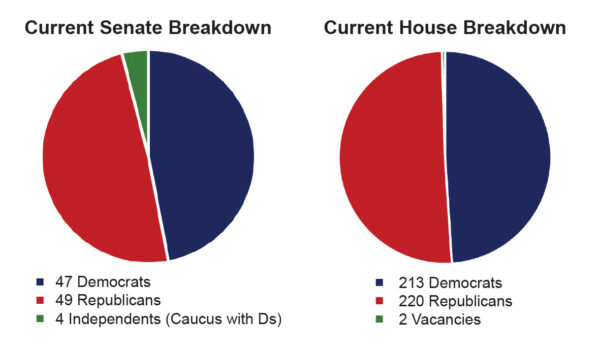
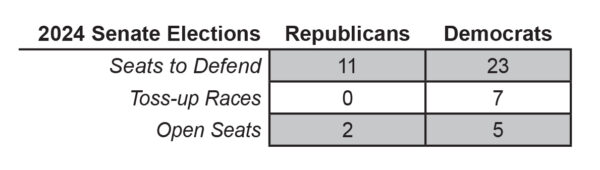
Neither party is expected to achieve a 60-seat supermajority required to overcome a filibuster. Democrats must defend twice as many seats as Republicans this cycle, and with Sen. Joe Manchin’s retirement (I-W.Va.) triggering an easy pick-up for Republicans, Democrats must win all toss-up races and the White House in order to retain a tie-breaking majority in the Senate.
Infrastructure Impacts: Key architects of the IIJA are retiring, including EPW Committee Chairman Tom Carper (D-Del.); Sen. Ben Cardin (D-Md.); Sen. Joe Manchin (I-W.Va.); Sen. Mitt Romney (R-Utah); and Sen. Kirsten Sinema (I-Ariz.).
Races to Watch: Sen. Tammy Baldwin (D-Wis.); Sen. Sherrod Brown (D-Ohio); Sen. Jacky Rosen (D-Nev.); Sen. John Tester (D-Mont.); OPEN-Ariz.; and OPEN-Mich.
U.S. House of Representatives
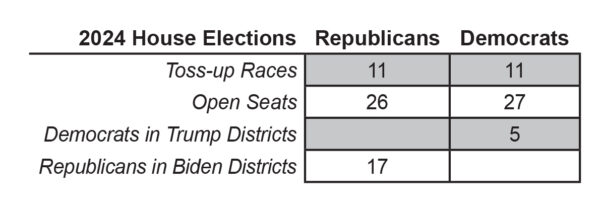
Close races and narrow margins will prevail, regardless of which party is in charge in the House.
All 435 seats will be up for election in November, though just 44 are considered competitive.
The 2022 elections were the first since the decennial redistricting process, but given legal challenges in several states, 2024 will also see voters selecting candidates from newly-drawn districts.
New maps in Alabama, Louisiana, New York and Wisconsin will create opportunities for Democrats to gain seats, while new districts in North Carolina offer likely pick-ups for Republicans.
Scenario Planning
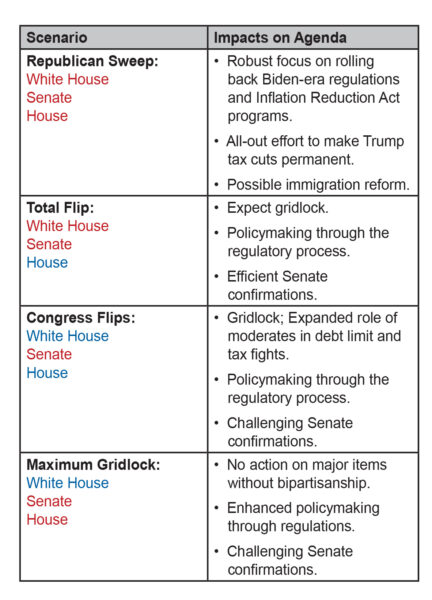
ARTBA’s goal of a timely and robust reauthorization of the highway and public transportation program that includes, or is preceded by, a permanent HTF revenue solution will remain no matter the outcome in November. Party control of the two ends of Pennsylvania Avenue, however, will impact our external environment and the context in which we pursue our priorities.
The chart below examines how the four most likely scenarios may shift the agenda in Washington.
Plan of Action
ARTBA will be working in the coming weeks to engage with candidates and inform them of the transportation construction community’s priorities.
Here’s what we’re doing:
- ARTBA partners with state chapter executives to host members of Congress at project sites around the country. These valuable trips help lawmakers see how their support for infrastructure improves constituents’ lives through job creation, safety and mobility benefits.
- “There’s no better way to understand the value our industry brings than seeing it firsthand. Over the course of a just a few hours, Rep. Marcy Kaptur saw the impact her support for the 2021 infrastructure law will have on improving safety and efficient travel for her district and the entire state.”
– Chris Runyan, executive director, Ohio Contractors Association
- “There’s no better way to understand the value our industry brings than seeing it firsthand. Over the course of a just a few hours, Rep. Marcy Kaptur saw the impact her support for the 2021 infrastructure law will have on improving safety and efficient travel for her district and the entire state.”
- Each week, the ARTBA Newsline will feature “Transportation on the Ballot,” highlighting candidates who are proven transportation advocates.
- Our Grassroots Action Center now features an Election Center where you can check your voting registration, find your polling place, and learn about early voting options in your district. Scan the QR code to access the site.
After Nov. 5, ARTBA will release an election report, highlighting outcomes from the elections and what the impacts will be to the 2025 transportation agenda.
Buckle up. This fall’s election season will be an interesting ride.
Related News
2024 Mid-Year Forecast: A Deluge of Regulatory Proposals & Court Rulings
by Prianka Sharma, vice president and counsel for regulatory affairs, ARTBA Remember earlier…
Supreme Shift: What the Chevron Ruling Means for Transportation Construction
by Prianka Sharma, vice president & counsel, regulatory affairs, ARTBA Earlier this year,…

The Road Ahead: 2024 Federal Legislative, Regulatory and Political Outlook
by Beth McGinn, vice president of communications, ARTBA Baseball legend Yogi Berra once…