
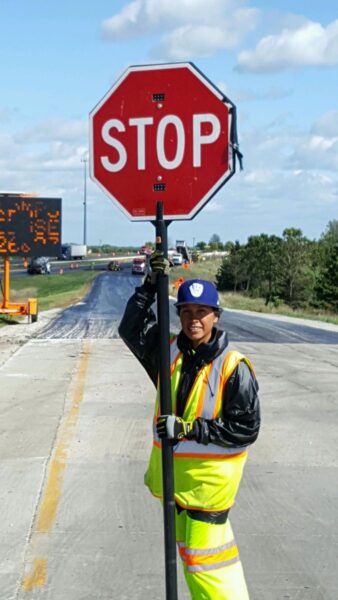
Tia Menore (pictured) left her minimum wage job at a local drugstore to take Highway Construction Skills Training (HCST) classes in 2015. Her first job after completing HCST was as a flagger. She is currently a materials coordinator with a concrete supplier in Green Bay, Wis.
by Chrisy Currier, strategic workforce development program manager, FHWA Office of Infrastructure, Construction Team; Natasha Young, communications associate, ICF Next; and Josh Alkire, senior copywriter, ICF Next
The U.S. Department of Transportation Federal Highway Administration’s (FHWA) Strategic Workforce Development (SWD) Program plays a pivotal role in addressing the growing demand for a highway construction workforce while breaking down barriers for individuals seeking career opportunities and community improvement.
Daniel Webster’s journey from a highway flagger to the director of diversity and inclusion at a construction management company in Waukesha, Wis., demonstrates the importance of combining opportunity and advocacy to benefit the community. His commitment to fostering diversity, equity, and inclusion (DEI) within the highway construction industry not only shaped his own career but also opened doors for and inspired numerous individuals from Tribal communities across the region to join him.
Daniel’s introduction to the construction industry came through the Highway Construction Skills Training (HCST) program, an intensive six-week initiative sponsored by the Wisconsin Department of Transportation (DOT) that prepares workers for careers in the road construction industry. In particular, HCST strives to create opportunities for underrepresented groups, including women and people of color.
Despite lacking prior experience, he started as a flagger and eventually grew into a traffic control position. Later in his career, he pursued higher education while working, earning both bachelor’s and master’s degrees in business administration. Now, Daniel collaborates with Noel Vandiver, Wisconsin DOT’s North Central Region HCST director, to prepare graduates for their upcoming careers in highway construction with activities such as job interview preparation, résumé writing, and time and wealth management.
In 2018, Daniel joined his current company as a human resources business partner, marking the beginning of his journey in championing DEI. Daniel recognized the underrepresentation of Tribal members in the industry, leading to his advocacy for increased outreach and recruitment efforts in Northeast Wisconsin. His efforts led to the hiring of more than 50 individuals from Tribal communities into the highway construction industry. His firsthand experience, coupled with his deep understanding of and involvement in Tribal communities, uniquely positioned him to spearhead initiatives aimed at diversifying the workforce.
One such initiative encompasses collaboration with HCST programs, particularly in Tribal communities. Through partnerships and outreach efforts, Daniel facilitates the entry of numerous individuals into the highway construction industry, providing them with opportunities and advice for training, mentorship, and employment.
The growing number of success stories emerging from these efforts is a testament to the transformative impact of proactive DEI initiatives within the heavy highway construction industry. Individuals who once lacked access to these opportunities now find themselves thriving in meaningful careers within the construction field.
One such success story is currently being written about Tia Menore, a materials coordinator with a concrete supplier in Green Bay, Wis. Looking for higher earnings potential for the betterment of her family, Tia left her minimum wage job at a local drugstore to take HCST classes in 2015.
A member of Ho-Chunk Nation, Tia’s first job after completing HCST was as a flagger. During that first season, her sense of curiosity led Tia to wonder about other aspects of the job: What’s in the dump trucks? How are the dump trucks being filled? Where did this material come from? How far do the dump trucks have to drive?
Her interest suitably piqued, Tia pursued a position working with materials. Today, she finds herself in her company’s quality control testing laboratory. But not for long, as Tia is transitioning to more of an “office” role, working with reclamation plans; engineering, procurement, and construction agreements; and the bidding process. This includes the opening and closing of pits and quarries, rezoning and conditional use, permits, and so forth.
Tia credits HCST for helping with more than just Occupational Safety and Health Administration certifications. The classes taught her what to expect on jobsites, the importance of a good work ethic, timeliness, and professionalism.
As Daniel continues to pave the way for inclusivity and equity within the highway construction industry, Tia, too, is creating a legacy of her own. She now takes civil engineering classes at Northeast Wisconsin Technical College.
By amplifying diverse voices and fostering a culture of belonging, FHWA’s SWD Program is not only transforming lives but also reshaping the future of Wisconsin’s highway construction industry.
For more information, please contact: christina.currier@dot.gov.
Editor’s Note: This is the fourth in a series of stories about how the industry is tackling workforce shortages. To share your workforce development success story, please email Carolyn Kramer Simons at csimons@artba.org.
Related News

ARTBA Members See Success Filling Jobs, Keeping Talent
by Carolyn Kramer Simons, ARTBA senior director, state funding policy While 2024 brought…

Helping Students Unlock Opportunity in the Aggregates Industry
by Megan Bick, marketing coordinator, Jurgensen Aggregates. People who work in the mining,…

Paving the Way for the Next Generation of Construction Professionals
by Todd Sutton, director of construction technology, Zachry Construction Corporation Several years ago,…