
by John Schneidawind, ARTBA vice president of public affairs
When it comes to fixing bridges, Maryland Transportation Authority (MDTA) Chief Engineer James Harkness rarely sees a project as challenging as the effort to “re-deck” parts of the Chesapeake Bay Bridge, a 70-year-old structure that is the key corridor for commuters and vacationers on the Eastern Shore of Maryland-Delaware.
“This bridge is four miles long, and we don’t have a lot of four-mile-long bridges in the region,” Harkness said. “So, it’s pretty unique in that respect.”
Length is just one challenge. Built in 1953, the structure has been buffeted for decades by wind and salt water that has taken a toll. Inspection after inspection showed that the concrete slabs serving as the span’s roadway platforms for cars and trucks were weakening and steadily deteriorating.
Yet closing portions of the bridge for such a major repair was not an option. While the number of vehicles crossing the Chesapeake Bay Bridge daily varies by day of the week and season, the span carries enormous volumes of traffic. During a typical week, more than 80,000 cars and trucks cross it daily. That number balloons to 92,000 vehicles on summer Saturdays, as vacationers head to and from the beaches.
“A lot of places where you’re seeing re-decking being carried out, you would figure out a way to reduce lane widths to make room to work and still maintain traffic,” Harkness explained. “The ability to take away some vehicular capacity is just not something we can do at this location.”
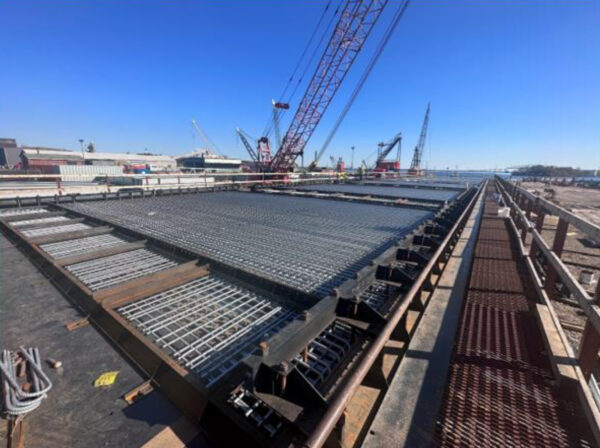
The only choice was to do repairs at night when traffic subsides. That meant approaching the rehabilitation effort from beneath the bridge—with the daunting task of replacing the deteriorating eastbound concrete decks with pre-cast sections fabricated off-site and delivered via barges to two platforms in the bay. The first section, on the Eastern Shore-side of the eastbound span, is nearly one mile of the overall 4.35-mile-long bridge. Areas of the existing eastbound deck are nearly 50 years old and are at the end of their service life.
The unconventional project was the focus of an ARTBA-hosted tour last October. Fifty-five U.S. House and Senate staffers got an up-close look at the $140 million effort awarded to ARTBA member Kokosing-McLean JV. Done by boat, the tour spotlighted the value of transportation investment.
Kokosing Regional Senior Vice President Greg Hamilton detailed how crews—weather permitting and working overnight—use cranes to remove existing decks, hoist new precast deck panels into place and reopen lanes in time for morning commuters.
“Volumes drop off very significantly, depending on the time of year, around eight or 10 at night,” Harkness said. “That’s when we can get out there, put all the traffic on the other bridge so we can maintain traffic [flow]. Then we have the full eastbound bridge to be able to carry out our work.”
“We’re able to go in there, cut out the deck piece, lift it out, put the new piece in, make it safe, and reopen by four or five in the morning,” he said.
Working with Kokosing, Harkness said the process of replacing old decks and installing new ones has been a learning experience that becomes more streamlined with each installation.
“This is not, you know, the industry standard way of doing a deck replacement,” he noted. “There was some experience there, but nothing beats getting out and starting to run through the process.”
For Kokosing’s Hamilton, it’s been a construction learning experience unlike any other.
“This is the first time in Kokosing’s 75-year history that we’ve ever undertaken a project like this,” Hamilton said. “MDTA put out a very unique contract to go do this job.”
“You’ve got to remember all of our work on replacing that deck is controlled by having that bridge closed overnight,” he said. “We’re working in these overnight windows, which vary depending on time of year and day of the week.”
“If we’re working from the deck itself up top,” Hamilton explained, “we couldn’t be out there prepping and getting ready for anything until that bridge is closed down, and then you’d be rush, rush, rush, get everything set up, tear out a piece and then try to get a piece put back.”
The project also includes barrier upgrades, structural rehabilitation of steel superstructure, lane-use signal gantry replacements, utility relocations and off-site stormwater management, according to the MDTA, which owns and operates the bridge.
Construction on this section of the eastbound deck replacement is expected to continue into May 2025, with additional sections to follow based on available funding and bridge conditions. The goal is to complete the entire project by 2026.
Meanwhile, MDTA asked for the public’s comment in December on an even bigger challenge—replacing the old Chesapeake Bay Bridge with a new one. Among the options being studied are two new bridges with six to 10 lanes, with the possible addition of bus and pedestrian lanes. The new spans would be taller than the current structure to accommodate larger ships.
A new bridge could cost anywhere from $7.3 billion to $8.4 billion, depending on the number of lanes, according to MDTA. If the agency stays with the existing 1953 span, maintaining it would cost an estimated $3.8 billion through 2065. The study phase will be complete in 2026.
“We know we’re going to spend nearly $4 billion just to maintain the bridges that we have,” Harkness observed. “And at the end of the day, you still have these very old bridges.”
“So, we’re trying to be mindful and very strategic about our current preservation plans,” he said. “We have to continue addressing the current needs because you don’t know about the future project, right? We have to proceed as if that’s not happening.”
Pictured above: Pre-cast steel and concrete panels fabricated off-site are delivered via barges and set on the bridge deck. Photo courtesy of Kokosing.
Related News

What’s NEXT in P3s – Virginia’s 495 Express Lanes Northern Extension
by Beau Memory As the second state in the nation to authorize public-private…
A Bridge to Faster Travel: Transurban’s Opitz Boulevard Project
by Transurban’s Jacqueline Woodbridge, Jennifer Modugno, P.E., and Jeff Taylor, P.E. Overlooking I-95…
Bridge Bundling Promotes Streamlined Delivery
by Sadie Dalton, HNTB project manager In southwest Florida, near the Big Cypress…