
by Beau Memory
As the second state in the nation to authorize public-private partnerships (P3s) for transportation, Virginia has consistently demonstrated how strategic collaboration between government and private industry can unlock innovative solutions to complex mobility challenges. These partnerships have enabled the development of cutting-edge transportation systems that serve millions of residents, visitors, and long-haulers alike along the I-95 corridor—the Main Street of the East Coast.
One of the most recent and impactful examples of this approach is the 495 Express Lanes Northern Extension—known as 495 NEXT—which is set to open to drivers later this year. Spearheaded by Transurban, in partnership with the Virginia Department of Transportation (VDOT), 495 NEXT represents the next chapter in a more than decade-long collaboration aimed at improving travel choices and reducing congestion in Northern Virginia.
The story of express lanes in Virginia began in 2012, when the original 495 Express Lanes opened to traffic. This dynamically priced, managed lane model quickly proved its worth in Northern Virginia and the greater region, offering faster, more reliable trips and easing congestion in one of the most heavily trafficked areas in the country. Building on that success, express lanes were extended to I-95 in 2014 and I-395 in 2019, with additional enhancements and expansions continuing to evolve the network. These projects, primarily funded by private investment, have saved Virginia taxpayers billions of dollars—resources that can be redirected to other critical priorities.
495 NEXT: A Small Stretch With Big Impact
Though 495 NEXT spans just 2.5 miles, its impact will be far-reaching. The extension will increase capacity through one of the worst traffic bottlenecks in the Washington, D.C., metropolitan area, particularly near the American Legion Bridge—one of the few crossings between Virginia and Maryland. By improving traffic flow and reducing travel times, the project will continue to provide and improve relief to commuters and long-distance travelers alike.
Moreover, the new express lanes will connect to major regional roadways, including the George Washington Memorial Parkway and Dulles Toll Road. These connections will enable more drivers to benefit from Northern Virginia’s express lanes network, offering faster, more predictable travel options and reducing impacts on local roads.
Beyond Congestion Relief: Infrastructure and Community Investment
While adding reliable I-495 travel choices is the core purpose of 495 NEXT, its benefits reach well beyond the roadway. Transurban’s private investment has enabled
a range of infrastructure improvements and community enhancements. This is a hallmark of the P3 model— unlocking additional value through strategic collaboration.
Along the project corridor, seven bridges maintained by the Commonwealth were identified as needing rehabilitation or widening to support the express lanes—and 495 NEXT incorporated their repair and replacement into the overall scope. This replacement and upgrade of bridges accommodates the widened Beltway, improves safety and reliability, and enhances the broader transportation network for years to come, without VDOT having to bear the costs.
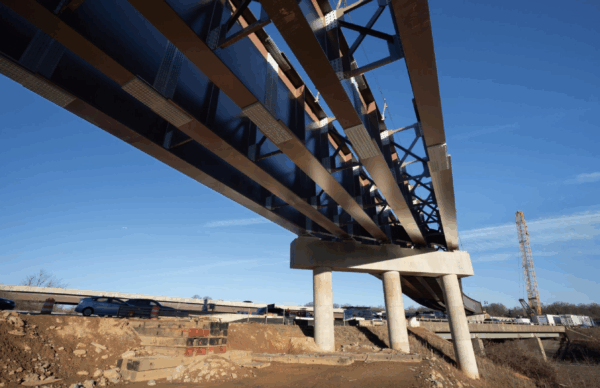
One of the most impressive engineering feats of the project occurred in January 2025, during an operation dubbed “Big Beam Weekend.” To install five lines of massive steel girders—each spanning 295 feet in length—teams had to reduce all traffic on the northbound Capital Beltway from six to two lanes near Tysons for an entire weekend. The success of this complex installation was made possible through meticulous coordination between Transurban, VDOT, and construction contractors, all of whom have built strong working relationships together over the course of Virginia’s long-standing P3 history. These girders will support a critical new connection from the Dulles Toll Road to the northbound 495 Express Lanes, helping to alleviate congestion not only on the Beltway but also on surrounding local roads.
Investing in the Community and Environment
495 NEXT is making a meaningful difference in the local community. To date, Transurban’s community initiative has contributed $115,000 in grants to nonprofit organizations focused on community resilience, environmental sustainability, and roadway safety. These investments reflect Transurban’s commitment to being a responsible partner—not just in transportation, but in the broader social and environmental fabric of the region.
The corridor will also benefit from the installation of a dedicated stormwater management system which will play a vital role in protecting roadways and communities from flooding and erosion. Additionally, the restoration of Scott’s Run, a local stream and tributary of the Potomac River, will stabilize its banks and prevent future degradation— preserving a valuable natural resource for generations to come. The project performed portions of stream bank stabilization and slope protection critical to protect roadway infrastructure, while also providing $1.387 million in funding to Fairfax County for its Scott’s Run Stream restoration project.
The Commonwealth of Virginia, along with Transurban, is funding new express bus service on I-495 from Tysons, Va., to Bethesda, Md. The initial $5.2 million investment to purchase the buses and $2 million from VDOT’s 495 NEXT Transportation Management Plan set up Route 798, with continued annual funding to come from Transurban. This includes a first payment of $2.2 million in 2025, for operations via Fairfax Connector bus service provided by Fairfax County, Va.
Residents will also enjoy new recreational opportunities thanks to the construction of four miles of bicycle and pedestrian facilities with a trail that is parallel to I-495, as well as a new parking area for Scott’s Run Nature Preserve. These trails and connections will provide access to existing regional networks, offering safe and scenic routes for walking, biking, and other forms of active transportation. By expanding mobility options beyond cars, 495 NEXT supports healthier lifestyles and more sustainable travel choices.
Innovative Financing: A Blueprint for Future Projects
One of the most remarkable aspects of 495 NEXT is how it was financed. The $660 million investment was made possible through a combination of innovative funding mechanisms, including the refinancing of Transurban’s existing regional assets during the low-interest environment of the COVID-19 pandemic. By capitalizing on favorable market conditions, the company was able to generate significant savings through lower interest rates, which were then reinvested into this project.
This creative approach, combined with private activity bonds (PABs), Transportation Infrastructure Finance and Innovation Act (TIFIA) loans, and other private capital sources ensured that the project could move forward without relying on taxpayer dollars. It’s a powerful example of how private sector ingenuity can complement public sector goals—delivering high-impact infrastructure while preserving public resources.
A Model for the Future
495 NEXT exemplifies the transformative potential of public-private partnerships. For Transurban, the express lanes are just one piece of a larger vision—one that includes building new neighborhood roads, rehabilitating aging infrastructure, investing in local communities, and protecting the environment. It’s a holistic approach to infrastructure development that prioritizes long-term value and sustainability.
As state and federal funding sources become increasingly constrained and infrastructure demands continue to grow, governments need to consider every tool in the toolbox, including innovative models like P3s to meet their needs. By tapping into private investment and expertise, they can unlock new possibilities for mobility, safety, and community development.
Virginia’s experience shows that when public and private entities work together with shared goals and mutual respect, the results can be extraordinary. 495 NEXT is not just a road—it’s a roadmap for how the public and private sectors can come together to improve communities.
Beau Memory is president of Transurban North America.
Related News

Re-decking the Chesapeake Bay Bridge: Mission Possible
by John Schneidawind, ARTBA vice president of public affairs When it comes to…
A Bridge to Faster Travel: Transurban’s Opitz Boulevard Project
by Transurban’s Jacqueline Woodbridge, Jennifer Modugno, P.E., and Jeff Taylor, P.E. Overlooking I-95…
Bridge Bundling Promotes Streamlined Delivery
by Sadie Dalton, HNTB project manager In southwest Florida, near the Big Cypress…