
by John Schneidawind, vice president of public affairs, ARTBA
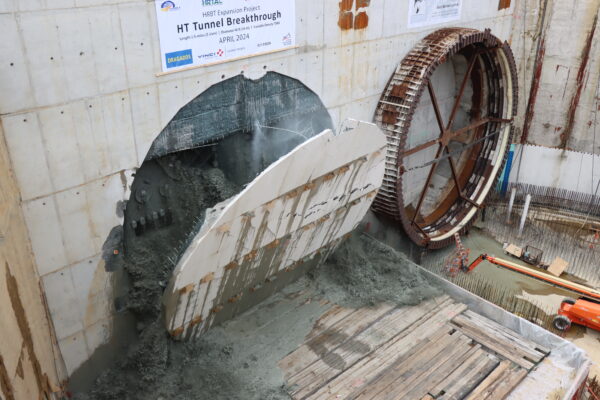
With a long, painful moan that belied her remarkable achievement, the 4,700-ton tunnel boring machine known simply as Mary breached the confines of the tunnel she had burrowed, marking a major milestone in one of America’s biggest and most complex transportation construction projects.
The hundreds of workers witnessing Mary’s emergence April 17 on North Island whooped and applauded as she pushed through her last barrier—a circular concrete slab that flopped intact in a cloud of dust to the bottom of a receiving pit like an immense, cement pizza pie.
Mary’s “breakthrough” was more than physical. It was also a vindication for the Virginia Department of Transportation’s (VDOT) Hampton Roads Bridge-Tunnel Expansion Project, a mammoth, almost $4 billion regional effort to relieve traffic congestion in part by expanding the traffic-clogged, four-lane segments along 10 miles of I-64 between Norfolk and Hampton with two, new twin-lane tunnels under Norfolk Harbor.
If you think that’s a tall order, you’re right. Decades in the making, the project is about 18 months behind schedule due in part to the pandemic and the painstaking re-assembly of the $70 million, 430-foot Mary when she arrived in the United States in December 2021 from Herrenknecht—her German manufacturer.
Add to that the challenges of drilling through almost 8,000 feet of rock, silt and unstable earth just 173 feet below the water’s surface, and you begin to appreciate the daunting assignment to which Mary—named after Mary Winston Jackson, NASA’s first female African American aerospace engineer and a Hampton native—has been assigned.
Mary’s journey to her first milestone began in April 2023. Now she must reverse herself to tunnel in the opposite direction—itself a five-month effort on a turntable-like structure at the bottom of the North Island pit—to dig a twin tunnel back to Norfolk. VDOT hopes Mary will reach Norfolk in 11 months, quicker than the 51 weeks she took boring through to North Island.
Project Director Ryan Banas so far is elated by Mary’s performance.
“We’ve been waiting for almost 30 years to see this progress, since the early 90s, so just a halfway milestone for us here but the lessons learned,” Banas told the Virginia Pilot. “The pulling together, as a team, proves that we can accomplish monumental things here in Hampton Roads.”
For Banas, on the job 18 months and a 13-year Hampton Roads resident, Mary’s breakthrough is one of a series of challenges faced by project owner VDOT, the Hampton Roads Transportation Accountability Commission (HRTAC) and the contractor—Hampton Roads Connector Partners (HRCP), a joint venture of Dragados USA, Vinci Construction, Flatiron Constructors and Dodin Campenbon Bernard. WSP USA is lead project consultant, while HNTB is contract manager.
The Hampton Roads/Norfolk region is home to 1.7 million residents, the world’s largest naval installation at Newport News, as well as the biggest container port on the eastern seaboard. It also boasts the world’s largest collection of 10 immersed tube tunnels and the first tunnel in the world between man-made islands.
The confluence of low-lying land, economic expansion and its complex transportation infrastructure has made the region one of the biggest challenges in the country for traffic management engineers. The existing Hampton Roads tunnel was designed to handle 60,000 vehicles each day. Now it’s clogged with 100,000 vehicles daily and six-mile backups during peak travel times. The goal is that the tunnel’s expansion will help ease the congestion.
But expanding the tunnel itself has been a daunting task for Banas’s team. From a financing standpoint, the design-build project appears to be on solid ground, delays notwithstanding. Almost all of its $3.9 billion price tag—92 percent—is funded from a regional gas tax and sales tax enacted in 2013, geared specifically for the project. The rest comes from state and federal funds, including $153.5 million from 2021’s Infrastructure Investment and Jobs Act, according to ARTBA Highway Dashboard data.
“So, the money goes to Richmond, and is immediately turned around and deposited into the HRTF (Hampton Roads Transportation Fund),” Banas explained. “And with that, we’re seeing about $180 million to $200 million a year in revenue that the fund receives.”
“As a taxpayer and a Hampton Roads resident… if I’m going to pay taxes, I’m happy to see it come back and put to use on roads that I’m going to drive on every day rather than to different parts of the state,” Banas said.
What’s not so solid is the actual ground through which Mary is boring. “We have very poor soils from a geotechnical standpoint, with very soft material, compressible clays, lots of sand and silt,” Banas said.
Complicating Mary’s task was boring a tunnel between the two North and South man-made islands, with even more tortuous geology. “So, you’ve got poor soil, and you’ve created these artificial islands,” Banas said. “Now you’ve got even more weight and you’ve got mixed geology because you’ve got man-made materials you’re mining through and the natural sands and soils beneath.”
“If you’ve got to go out and dig a small hole in your backyard that’s three inches big, you can probably find an area where the soil’s pretty homogeneous and then you know how to handle it,” Banas said. “But when you’re talking about a hole that’s 46 feet in diameter, it’s very common that you would have ‘mixed space’ conditions. What might work at the bottom where there’s clay doesn’t necessarily work well with sand and that might not work well with silt that’s in the middle.”
That problem was solved through the arduous process of installing rectangular cement columns horizontally to stabilize the ground on which the almost 10 million-pound Mary was drilling. “She’s heavy, she wants to settle, she wants to shift,” Banas said. “On poorer soils we can’t afford that, so we have to improve that ground to keep her where we want her to be.”
Banas rattled off a series of other challenges and discoveries Mary and her team have met or encountered:
- Civil War ordnance. “We are home to the battle of the Ironclads,” Banas noted. Mary came upon still- live cannon balls from the Battle of Hampton Roads between the USS Monitor and the CSS Virginia (formerly the USS Merrimack) in 1862. Experts from nearby Joint Base Langley-Eustis were dispatched to explode the ammunition.
- A 50,000-year-old mastodon, including a partial tooth, rib, limb, and vertebrae.
- The South Island from which Mary began her journey was home to one of the largest colonies of birds that are a protected species. “When we came to start our construction, we couldn’t just displace those birds and not give them an additional area to go,” Bamas said. The project brought in barges covered with sand to create another habitat for nesting each year between April and September. And it uses border collies to chase nesting birds away from the construction site.
- Teddy the Sea Turtle. To prevent settlement due to rising sea levels and porous soil, the project added 15 acres to the North Island, building from the outside in and creating a berm with a pool to fill with material later. But a sea turtle broke into the pool and wouldn’t leave, forcing a deconstruction of the berm to let the animal out—though it took Teddy two weeks to make his exit. “Teddy the Turtle has gone down in project lore as being an unwelcome guest, but one that we were happy to entertain while he was here,” Banas said. “But man, we were happy to see him go.”
Climate change, rising sea levels and storm surges are continuing threats that Banas and his project team prepare for every day. Banas’s home itself is barely six feet above sea level, and storm surges between eight and nine feet in the region are common.
“For us, throughout the project corridor, stormwater management is a huge effort we go through, and it’s very challenging because of the poor soil conditions, but also because we’re so low lying,” Banas says. “It’s trying to find enough slope to drain water when you’re already darn near at water level.”
While Mary’s recent breakthrough is the most recent project development, it’s important to remember that the entire Hampton Roads project is more than just a tunnel. Five bridges are being replaced, 20 bridges are being rehabilitated or widened, a mile of interstate highway is being widened in Hampton, and four miles of interstate are being widened in Norfolk. The project is also adding two general purpose lanes, plus a Hampton Roads Express Lane, as part of a 45-mile continuous network.
With a nearly $4 billion price tag, project goals are for the new system to last at least a century, even with a harsh environment occasioned by storms. Corrosive salt spray is a constant factor, forcing project designers to use stainless steel in bridge construction to prevent rust and corrosion.
“At one point in one of our years, we were consuming about one percent of the world’s stainless steel,” Banas recalls. “We really looked at it from a perspective of getting these facilities out of the salt spray. We can’t run the risk of those systems and their support infrastructure corroding, requiring replacement and having down time.”
“There’s a great likelihood that these tunnels will be here for a couple of hundred years,” Banas said.
Above photo: The tunnel boring machine nicknamed Mary broke through the headwall April 17 into a receiving pit on North Island, achieving a major milestone in the Hampton Roads Bridge-Tunnel expansion project. Courtesy of VDOT.
Related News
What’s NEXT in P3s – Virginia’s 495 Express Lanes Northern Extension
by Beau Memory As the second state in the nation to authorize public-private…

Re-decking the Chesapeake Bay Bridge: Mission Possible
by John Schneidawind, ARTBA vice president of public affairs When it comes to…
A Bridge to Faster Travel: Transurban’s Opitz Boulevard Project
by Transurban’s Jacqueline Woodbridge, Jennifer Modugno, P.E., and Jeff Taylor, P.E. Overlooking I-95…