
by John Schneidawind, vice president of public affairs, ARTBA
Paul Wiedefeld is no stranger to high-profile events in transportation. As chief executive officer of the Washington Metropolitan Area Transit Authority (WMATA) from 2015 to 2022, Wiedefeld coped with a series of train derailments, funding shortfalls and an unforeseen global pandemic from which D.C.’s Metro system is still trying to recover.
But nothing compares with the call he received in the wee hours of March 26, 2024, informing him that the massive container ship Dali had plowed into the Francis Scott Key Bridge in Baltimore’s Patapsco River, collapsing the span, killing six road maintenance workers and throwing Baltimore’s entire transportation ecosystem into momentary chaos. As Transportation Builder goes to press, the state has successfully reopened the crucial shipping channel. The bridge was broken into smaller pieces, more than 1,300 tons of steel debris was cleared, and the Dali was freed from the tangle of steel in which it was enmeshed.
Sworn in as Maryland Department of Transportation (MDOT) Secretary on March 2, 2023, Wiedefeld is drawing on some 40 years of experience to deal with the disaster, including transportation posts in both public and private sectors. At MDOT, he oversees six agencies and leads operations and maintenance of state highways, bridges, tollways, transit systems, motor vehicle licensing, Baltimore/Washington International Thurgood Marshall Airport and the Helen Delich Bentley Port of Baltimore.
Here’s an edited transcript of a May interview with Wiedefeld and ARTBA Vice President of Public Affairs John Schneidawind:
Q: Can you give us a thumbnail sketch of how you run Maryland’s transportation system?
A: I’d like to point to the uniqueness of Maryland’s transportation department; all the modes of transportation are under the secretary’s office, and a consolidated trust fund to support the modes. Then we have the toll authority, which has its own authority for revenues, but is still under the office of the secretary.
That gives us tremendous opportunity to leverage dollars, to leverage political capital to be frank, and to deal with community issues. It gives us the ability to support overall statewide policies. And particularly under this administration, with its focus on not just how we efficiently move people and goods from point A to point B, but also do that in a manner that supports larger societal goals—whether they be child poverty, climate, or economic development. We have the tools of the airport, the port, the highways, and the transit system both in Washington and Baltimore. So, when you have an incident like we’ve had with Francis Scott Key Bridge, we’re able to bring all those resources to the table, both in terms of our response and as we think long term about how we’re going to deal with this.
Q: How has the bridge collapse affected traffic and toll revenue? Has the revenue loss from the bridge collapse been mitigated by people finding other ways to get around?
A: There will be a loss. Clearly, we’ve seen increases in traffic on the two tunnels. We’ve seen this diffusion of traffic through some of the communities. Basically, a lot of the traffic is now going around the Beltway, which is not tolled. And then all the hazmat traffic, high loads and wide loads cannot go through the two toll facilities.
Q: How much of a traffic delay has emerged?
A: We’re seeing anywhere from 20-minute to 30-minute delays now in traditional peak period travel patterns.
Q: Is there an estimate yet as to the actual revenue loss?
A: Not yet. We were generating roughly about $56 million a year out of the Francis Scott Key Bridge revenues. Again, some of that is being diverted to the two tunnels. So, we have to think much more globally about how we attack this. And again, that’s the value of the port and state highway and the toll authority coming at this together. We are all at the same time working with transit and the business community on transit traffic demand, traffic management approaches, whether there should be changes again in teleworking, and when employees come in and out of work to help address the traffic conditions in the wake of the incident.
Q: How did the transportation construction industry—including any ARTBA members—help you in the immediate hours after the bridge collapse? We’ve heard that Skanska, for one, was pulled off the Harry Nice Bridge project.
A: We had (Skanska) under contract through a competitive process, so they had done work for us. You can imagine literally within hours of the collapse, we were trying to mobilize every resource we had. We had very large cranes for instance at the Chesapeake Bay Bridge where we were doing some major rehab. We started to mobilize them, and then Skanska had done a lot of work for us at the Nice Bridge and had done a lot of the salvage type issues down there. So, we brought them in right away.
Just so you understand, the channel under the bridge is the responsibility of the U.S. Army Corp of Engineers, and outside of that is the responsibility of the state of Maryland. We provided those resources to Unified Command. We just said, “Look, this is another tool in your toolbox,” and they started to use them right away. The first three openings of the harbor were done, in effect, primarily through that contract.
Q: What is your goal for re-opening the bridge?
A: As you can imagine, there was a lot of port traffic that went back and forth across that bridge—so it’s a port issue, but then it’s this larger regional issue. What we’re pursuing is a progressive design-build approach to try to basically pick up some time there. We estimate roughly four years—fall of 2028. We’re a little bit more than five weeks into this, and doing the best intensive engineering we possibly can in a five-week time period.
Q: What’s the cost?
A: We’re estimating $1.7 to $1.9 billion.
Q: When will the construction start?
A: Our initial focus will be on demolition. If that’s what does occur, then let’s get that contract moving and get through that process or are there things there we can save that could support a future structure.
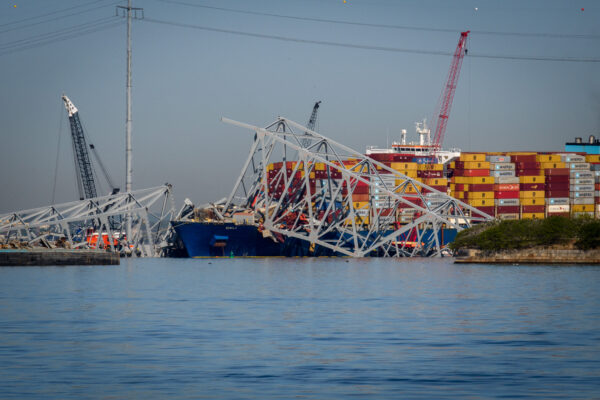
The collapsed Francis Scott Key Bridge rests on top of the cargo ship Dali in the Baltimore Harbor in an undated photo provided by MDOT.
Q: Before the bridge collapsed, Maryland Gov. Wes Moore in December proposed cutting $2 billion out of transportation funding due to budget shortfalls. After the bridge collapse, Annapolis lawmakers in April managed to pass a bill to generate up to $350 million in transportation revenue annually. Was the COVID money running out the main reason for the shortfall?
A: It was one of the factors. The cost of doing business has gone up because of inflation. Over time, what you can deliver for that same dollar you cannot deliver any longer. The time on a lot of projects has been pushed out because of labor and materials. These are things that the industry’s been wrestling with.
Then, when you add on top of that the uniqueness of this region, which had two major transit authority systems, and the fact that the decision was made during COVID that we want those systems to continue to operate at the same level for lots of reasons, and you can see why a shortfall developed.
One option obviously at that time would have been, okay, we’ll let all these people go. But that was not the national policy. That decision—at the time—was supported by COVID money, which is now dried up. To continue to deliver the services that you use at the Metro around the corner from you, those bills continue to grow as we continue to commit.
And also, I think an industry issue we all wrestle with is the state of good repair.
Those are significant dollars. And associated with that is the technology, the systems, that support these, the ability to run the system itself—those are things that literally you cannot find. Technology has changed over time, and you’re replacing all that.
Q: So where do things stand in Annapolis right now?
A: The governor and the legislature felt it was not the time to go after an aggressive revenue proposal. So, there were some dollars put in which allowed us to do some of the core things we do. We were proposing significant cuts—particularly on the basics like reducing hours in the motor vehicle administration, restricting some of the transit operations, and picking up litter on highways.
We backfilled some of those basics, but the core issue is still there, and they’ve set up a commission that is going to address it before our session starts. They will have 90 days after the new year to work through those issues in finer detail.
Q: With the bridge collapse, and the tragedy of six roadway workers losing their lives along with countless other damages and delays, what’s your thinking about how that disaster has affected the attitude of legislators in Annapolis? Has it made them more conscious of the public’s dependency on transportation systems? Is it the seminal event that changes attitudes?
A: I think it has—on two levels. Clearly, what you see is the importance of infrastructure on so many levels—literally from a base community identity. That bridge was part of the culture of some of those communities. Yes, physically, it provided mobility. But at the end of the day, it was part of their community.
Then roughly it was about 250,000 vehicles a day between the three crossings—almost 40,000 at peak periods. So, a relatively small amount compared to the other two, but even that small amount quickly changes the balance of the system. So that’s coming into clearer focus.
The other thing that’s coming into clearer focus is the professionalism of this industry. To do what we’ve done over the last six weeks—the Corps of Engineers, Coast Guards, Toll Authority, the highway team—for all of us to wrestle with this, come out with a strategy and then implement that strategy literally overnight is an achievement.
It reinforces that when we spend these dollars, and we spend them wisely and efficiently, we’re delivering something that people need. That is an overarching message not only to Annapolis, but to the public at-large.
Related News

Vicki Kramer Has Clear Transportation Goals for the Cornhusker State
by John Schneidawind, vice president of public affairs, ARTBA Vicki Kramer was appointed…

“From the Bronx to Buffalo”
by John Schneidawind, vice president of public affairs, ARTBA Marie Therese Dominguez has…

How the Infrastructure Law Helps GDOT Keep Pace With a Booming Economy
by John Schneidawind, vice president of public affairs, ARTBA Russell McMurry, P.E., commissioner…