
by John Schneidawind, vice president of public affairs, ARTBA
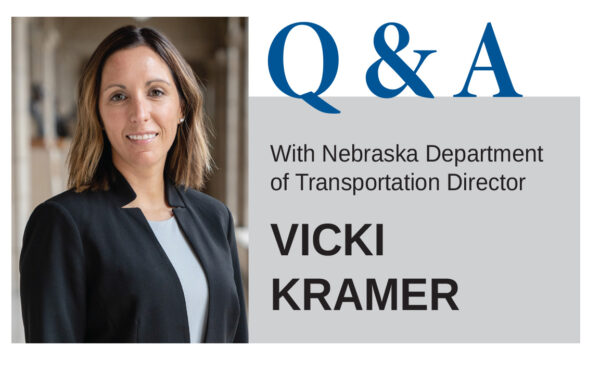
Vicki Kramer was appointed director of the Nebraska Department of Transportation (NDOT) by Gov. Jim Pillen in 2023, and leads an agency focused on customer service, cultivating partnerships, and improving mobility. From 2016 to 2020, she worked for NDOT as communications and public policy director, and as strategic advisor to the director. Before returning to NDOT in 2023, Kramer served as chief of staff for the Infrastructure Markets and Strategy Group at Kiewit Infrastructure Engineering.
She recently sat down for an interview with ARTBA Vice President of Public Affairs John Schneidawind.
Q: What are the unique challenges you face as director of Nebraska’s DOT?
A: As an industry, we are all striving to balance resources against needs. Whether funding or people, we are challenged with finding innovative ways to meet our capital and maintenance needs. Nebraska is heavily dependent on federal funds to support our transportation system; we’ve focused on getting the most out of our formula funds while moving our capital improvement needs forward through funding from the Build Nebraska Act and the Transportation Innovation Act.
Back in 2013, we started delivering expressway projects funded by the 2011 Build Nebraska Act. We are now a decade into that commitment and have delivered 15 large capacity building projects while also maintaining our system to a high level, measured by what we call the Nebraska Serviceability Index (NSI).
Q: How have the historic levels of new federal investment in the infrastructure law helped shape your state’s program?
A: When we discuss the Infrastructure Investment and Jobs Act (IIJA), the first thing I must do is manage expectations. The highway bill portion of the IIJA was a 15 percent increase in formula funds as well as four new buckets of funding in politically charged areas. That 15 percent formula increase, factoring in the two percent growth in years forward, has been dramatically diminished by inflation, which has been anywhere from nine to 31 percent, depending on the quantities, the project, and what’s involved. So, we have not seen the buying power increase that is expected when people talk about a once in a generation investment.
Much of the opportunity is within the U.S. Department of Transportation-controlled discretionary grant program and fueled by the administration’s priorities. Nebraska has been awarded a few discretionary grants—anywhere from about $12 million to $20 million—but they haven’t been as competitive as what some other states have seen. I definitely understand that the intent of the IIJA is to fund projects for which there was really no other source of revenue—the Cape Cod bridges, the Brent Spence Bridge—those landmark projects. Our rural system, as well as I-80, is incredibly important to economic vitality and we’d like to see it valued as such.
Q: What was your solution?
A: One of the first things we did was to be very honest with ourselves in how unsuccessful we were—49th in federal discretionary funds awarded. We had not been competitive in telling our story and it had an impact across multiple layers of government and awarding sources.
So, in August we launched the Nebraska Infrastructure Hub, that is really focused on helping local and state agencies competitively compete for federal discretionary grants for transportation projects that they might otherwise struggle to fund… Governor Pillen and members of our legislative body were extremely responsive to that need. We built a grant pairing portal to help match projects with suitable federal grants, and then layered in a project development support team who can provide feedback on applications and proposals, and a technical assistance team to give guidance on aspects like cost-benefit analyses.
Q: What role does alternative delivery play in your program and how do you see these methods developing in your state?
A: NDOT has had alternative delivery authority since 2017 and has advertised two projects. Our first was a Design-Build project, and the second was a Construction Manager/General Contractor (CMGC). Neither of them made it to completion. We added P3 and Progressive Design-Build authority in 2022. Of note, the authorizing bill was passed unanimously.
As a state that always delivered projects through a “pay as you go” model, we have very much dedicated ourselves to modernizing our project delivery process as well as our approach to innovative finance. We hired a director of innovative finance and worked with the legislature to authorize the issuance of bonds early in 2024.
When I came back to NDOT, I had just spent the last three years at Kiewit as an alternative delivery director, seeing how these large-scale projects come together. We began the process of breaking down the vacuum. Nebraska was one of few states trying to establish an alternative delivery program without the help of consultants, and that was a major struggle for procurement and establishment of a program.
We took a step back and hired an owner’s representative to manage our alternative delivery program, educate internal and external stakeholders and help make sure our program is sustainable. The questions were, “How do we change our approach to be more competitive? How do we identify the best qualified contractors, and which projects will benefit from early contractor involvement? And how do we act as a good owner?”
Q: What made you leave NDOT for Kiewit, and then come back?
A: I chose the construction industry because I wanted to better understand the built environment. Getting projects done for the public and what owners take into consideration versus what contractors take into consideration—there were blind spots in that equation for me. The understanding of risk and the way each demographic thinks about it and puts value on it fascinates me. My time at Kiewit allowed me to build knowledge and to understand how the contracting industry values owners, how to have the tough conversations and what their expectations are of owners. It helped me see the importance of relationships and trust and how through a shared understanding, you can influence everything from safety to economic vitality.
For me, coming back was not expected, but when the governor calls, and he calls more than once, you answer. So, at 38, there’s a lot of runway left. And this is a very unique time to lead NDOT—I look forward to what we can accomplish together.
Related News

“From the Bronx to Buffalo”
by John Schneidawind, vice president of public affairs, ARTBA Marie Therese Dominguez has…

How the Infrastructure Law Helps GDOT Keep Pace With a Booming Economy
by John Schneidawind, vice president of public affairs, ARTBA Russell McMurry, P.E., commissioner…

A Transportation Veteran Takes On His Biggest Challenge
by John Schneidawind, vice president of public affairs, ARTBA Paul Wiedefeld is no…