
by John Schneidawind, vice president of public affairs, ARTBA
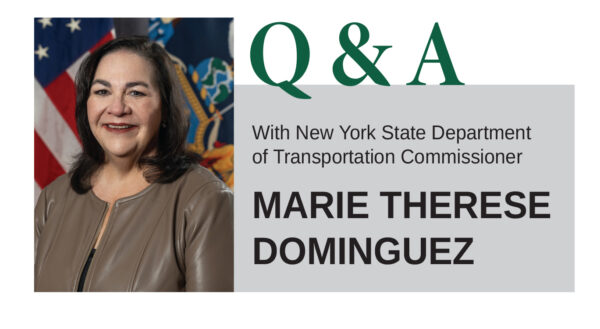
Marie Therese Dominguez has been New York State Department of Transportation (NYSDOT) Commissioner since June 2019, and has worked in the transportation, water and energy infrastructure, safety and logistics sectors for more than a quarter century, serving in numerous executive leadership positions with the federal government and private sector. She leads a team of 8,520 professionals responsible for planning, constructing, and maintaining the transportation systems critical to the Empire State’s global economic competitiveness.
Dominguez sat down with ARTBA Vice President of Public Affairs John Schneidawind to discuss the state’s programs. Here’s an edited transcript of the interview:
Q: Why don’t we start by you giving us an overview of the state of transportation in New York?
A: We’re at a unique place that the state’s never been in before. With Gov. Kathy Hochul coming into office we have been provided an opportunity for more funding for infrastructure in the state—more than any prior executive. And it came at a time when, in addition to state funding, the bipartisan infrastructure legislation passed. New York is leveraging a record level of investment—$33 billion in a five-year capital plan. We’ve got a program that, heretofore, we had not seen in terms of investment dollars. It is exciting, but just like every other state around the country, we are also faced with the impacts of supply chain and inflation and other cost increases. We’re trying to maximize every dollar we receive—putting these dollars to work across the State of New York.
Q: And how are you doing that?
A: We’re flexing our state dollars where we know we have opportunities. For instance, we have launched a $230 million upstate airport competition. We’re investing in our commercial airports upstate which are economic drivers for communities like Albany, Binghamton, Syracuse and Rochester. These are commercial airports outside of JFK and LaGuardia, which are run by the Port Authority. In addition, we are expanding our transit for systems in upstate New York, to include on-demand services.
Historically, the development of our transportation network started with the establishment of New York City and has grown as the population has expanded across the state. New York has some of the oldest infrastructure in the country. As such, we have some big challenges because our infrastructure is aging, and it’s aging quickly. As we invest, we want to make sure that we’re investing wisely across all our asset classes. In doing so, we are taking climate change and resiliency into account.
Q: How are you addressing the impacts of climate change?
A: What I mean by that is making sure that we’re building for resiliency. What we’ve seen in New York over the past few years is a level of increased intensity of rain that’s extreme—more rain in a shorter period. The impact on our infrastructure is such that last summer in the Hudson Valley we had an intense rainstorm near West Point,
and we almost lost a bridge. It was a critical bridge for the local community.
In response, NYSDOT has enhanced its engineering standards to make sure that we’re addressing the extreme hydraulic input that we’re seeing across the system. Specifically, we are increasing our predictive flow rates by 10-20 percent to account for future change—raising our bridges higher and making them longer—which allows for a higher flow rate. We are also building our structures where we can, with integral abutments on piles. We are utilizing details that have a higher level of resistance to higher hydraulic flows—thus hardening our infrastructure against the higher flow rates that we are seeing across the state.
Bottom line: we are making sure our requirements reflect the changing climate and that we are building for resiliency—today and into the future.
Q: We’re in year-three of the Infrastructure Investment and Jobs Act (IIJA). How have the historic levels of federal investment helped shape your state program?
A: I think it’s twofold. One, investing in the core program for our roads and bridges, and two, really understanding that we have a unique opportunity with the discretionary grant programs offered under the IIJA. One of the things that the IIJA gave us was the ability to look at how we undo some of the planning mistakes of the last 75 years and reconnect communities.
NYSDOT has been driving, arguably more than any other state, to reconnect communities so we were ready when the IIJA passed, to leverage new federal funding. New York had projects ready to go—transformative projects we were focusing on—projects that fundamentally address the separation that occurred in many communities across New York State during the 1960s and 1970s when highways cut through communities and literally left people behind. From the Bronx to Buffalo, we have five major transformational projects valued at over $5 billion that are absolute game changers, including the I-81 viaduct project in Syracuse, the Livingston Avenue Bridge project in Albany, and the Kensington in Buffalo, to name a few.
Q: What trends are you seeing in your workforce and what are you doing to attract and retain talent?
A: I will tell you that it is the challenge of our time. At a time where we have record level of investment and great opportunities, we also have a workforce challenge in New York. If you look at our workforce, we’ve had the opportunity to hire and retain really good folks—investing in them, their development, their training and career is core to our strategic plan.
All of that said, in the 1990s, New York State government went through some significant peaks and valleys. The state was able to hire hundreds of people in the early 90s, followed by decades of hiring freezes. So, what we’re seeing now is the people that were hired in the early 90s are now retiring. As a result, our managers are moving up faster, taking on more responsibility at earlier points in their careers, while we are recruiting and hiring a whole new cadre of transportation professionals. Our NYSDOT strategic plan is focused on our people and our organization, and we have just hired a chief people officer and completely changed our focus on recruiting, retention, training and workforce succession planning because our people are vital to everything that we do. I call our team members our “secret sauce.”
Q: What are some of the ways that you stay in touch and work with the industry in your state?
A: We have a very robust engagement structure with the industry. We have monthly meetings with a cross section of the industry here in New York State. This fosters good communication, whether it’s budgeting, contracting or workforce issues, or opportunities to collaborate on safety legislation.
One of the things that we’re hand in glove with the industry on is worker protection. We had an automated work zone speed camera enforcement program that we put forward a couple of years ago, a pilot program. It’s gone extremely well. We launched it in the summer of 2023. Our key stakeholders in industry, labor and law enforcement came together, and we’ve had a lot of success.
Now we’re looking at worker assault legislation. There are frustrated and distracted drivers who are not paying attention and speeding through work zones which in turn is placing our highway maintenance folks in danger. Sadly, we have had deaths on the roadways because of this. I got video the other day of a gentleman who literally got out of his car and ran up to one of our highway maintenance employees—a flagger—and gave him a karate-style kick and then ran back to his car and sped away.
Assault legislation has been passed for transit and dock workers in the state of New York, and this year we are asking the state legislature to extend the protections to highway workers.
Related News

Vicki Kramer Has Clear Transportation Goals for the Cornhusker State
by John Schneidawind, vice president of public affairs, ARTBA Vicki Kramer was appointed…

How the Infrastructure Law Helps GDOT Keep Pace With a Booming Economy
by John Schneidawind, vice president of public affairs, ARTBA Russell McMurry, P.E., commissioner…

A Transportation Veteran Takes On His Biggest Challenge
by John Schneidawind, vice president of public affairs, ARTBA Paul Wiedefeld is no…