
by John Schneidawind, ARTBA vice president of public affairs
John Schweppenheiser III, Naik Consulting Group senior vice president, has an apt name for the hole his team has begun excavating.
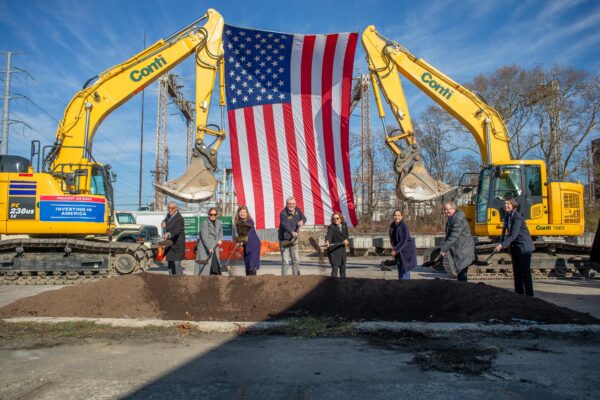
“What you’re looking at now is the gateway to the Gateway,” he says, pointing to a muddy triangular-wide cavity under Tonnelle Avenue in North Bergen, N.J.
The dig heralds the birth of one of the biggest and most critical transportation improvement projects in the nation.
The Gateway Program’s Hudson Tunnel Project (HTP) is a massive, $16 billion effort to drill a new tunnel containing two new tracks through the granite cliffs of New Jersey’s Palisades, under the soft belly of the Hudson River, and into the Big Apple just west of Madison Square Garden.
The goal is to ease the chronic delays plaguing Amtrak and New Jersey Transit commuters into and out of Manhattan.
The original North River two-track tunnel under the Hudson, which is also being refurbished, was completed in 1910. Age and the elements have taken their toll. It was badly damaged with floodwater during Hurricane Sandy in 2012. Corroded wiring, cracking concrete, and other structural issues now create constant delays that not only affect regional commuters, but also force national rail traffic between Washington and Boston to slow at times to a crawl.
Despite its antiquity, millions of commuters still depend on the tunnel for transportation along America’s Northeast Corridor, the busiest passenger rail line in the country. Roughly 200,000 passengers per day—over 80,000 on New Jersey Transit alone—use the tunnels to travel between the Garden State and Manhattan. One small hiccup can grind the entire system to a halt.
That’s why the HTP, a dream of transportation planners for decades, is seen as the long-overdue solution.
On July 9, that dream came true when the Biden administration awarded a $6.88 billion grant, the final tranche of money that totals $12 billion—the largest federal funding commitment to a rail transportation project in modern history.
The total cost of the HTP is being split 70/30 between the federal government and the project’s local partners: the Empire and Garden states and the Port Authority of New York and New Jersey. All three entities are funding the local share of the project through $4.06 billion in Railroad Rehabilitation and Improvement Financing (RRIF) loans from the Build America Bureau. Amtrak will be in charge of tunnel operations and maintenance.
While the goal is for the new passage to be completed by 2035 and the old tunnel renovation by 2038, the hard work is just really beginning. The list of project contractors reads like a who’s who of transportation design and construction firms. In addition to Naik Consulting Group, WSP, AECOM, and STV are part of the Gateway Trans-Hudson Partnership (GTHP), a joint venture that provides design and construction services for the Hudson Tunnel Project. Kiewit subsidiary Weeks Marine Inc., a New Jersey-based marine construction and dredging company, won the contract to stabilize the Hudson River’s riverbed so that the tunnel boring machine can drill without causing damage. In August, Schiavone Dragados Lane JV was awarded the contract to build the first mile of twin-tunnels on the New Jersey side of the river.
Construction began in late 2023: preparatory work before huge tunnel boring machines (TBMs) arrive on the scene. At Tonnelle Avenue, workers had to remove remnants of the $8.7 billion Access to the Region’s Core (ARC) plan. ARC would have built the two new tunnels Gateway will now build, except that former New Jersey Republican Gov. Chris Christie canceled ARC in October 2010, alleging his state would bear the brunt of any cost overruns.
On New York’s West Side, workers are busy just under the city’s famed High Line Park on 12th Avenue building the concrete casing that will connect the tunnel into Penn Station. And in the middle of the river is the Hudson River Ground Stabilization Project (HRGS), which is performing surveys to stabilize the soft riverbed on the New York City side, enabling tunnel boring machines to excavate. According to Gateway, the goal is to create a block of reinforced earth strong enough for tunnel construction
to begin.
Overseeing much of this activity is Gateway Senior Technical Advisor Jim Morrison, who says preparing the site for the boring machines has been the most difficult aspect of the work so far.
“The challenges are getting ready to do the tunnel,” Morrison said. “This may sound a little different, but the tunnel’s the easy part.”
“It’s getting everything prepared and ready for the tunnel, and then the next really complicated part comes in filling that tunnel ultimately with all the equipment required to run a train,” Morrison added. “The system side of this is really complex.”
Oddly enough, cutting through the solid rock in New Jersey’s Palisades isn’t the most daunting challenge, according to Morrison. Gateway hasn’t yet set a date for when the boring will begin.
“It’s fairly deep under the Palisades, like 280 feet of rock cover,” Morrison said. “Once it’s cut, which is really just a matter of horsepower, the cutting head on a tunnel boring machine puts pressure on the face and turns a cutting head and the rock splits away. It stands up by itself.”
“It’s probably easier than the soft ground,” he said. “The tunneling system that will go under the river—that will be in soft ground for the most part. It’s really two different technologies at play.”
That’s because the Hudson River’s bed is a mixture of mud, silt and soft soil that requires stabilization before any boring machines can begin actual drilling.
“This is being done ahead of time for the Hudson River tunnel, to mine through an area that has the shallowest cover, and to strengthen the ground to allow for safe mining through that area, remove any obstructions and protect the river from anything bad happening during mining,” Morrison said.
“The one (obstruction) that would really screw up the equipment would be an old cable anchor that winds it up and binds up the cutting equipment,” he said. “That’s probably worse than having to dig out an old ship, in terms of impact.”
Once the boring machine finishes tunneling under the Hudson, the next challenge will be safely breaching the bulkhead, or river wall that stretches from the city’s Battery Park to 59th Street on Manhattan’s West Side. The granite structure establishes a solid shoreline and a clear way to navigate the river.
“Allowing for that tunnel boring machine to come under the river and exit cleanly at 12th Avenue—that’s probably the most technically challenging piece of work,” Morrison adds, “because of the proximity coming into Manhattan and all of the utilities and potential third-party impacts, let alone that you have to get through the bulkhead that dates back to the late 1800s.”
Meanwhile, it’s important to realize that the Gateway Program is more than a new tunnel. It includes other endeavors to increase infrastructure capacity throughout the Northeast Corridor.
Some of the other significant projects that are part of the Gateway Program include:
- A New Portal North Bridge: Key to upgrading the system is replacing this span, a 110-year-old swing bridge over New Jersey’s Hackensack River. The structure often gets stuck, creating huge bottlenecks. A new fixed span bridge will increase rail capacity.
- Expansion of Secaucus Junction: Adding capacity where New Jersey Transit passengers switch trains on their way to Manhattan will increase the number of trains that can run at the same time.
- Expansion of New York’s Penn Station: The Gateway Program includes plans to expand the station to accommodate more passengers and augment train operations. Plans also call for track and platform upgrades.
Active construction on the Hudson Tunnel Project currently represents more than $1 billion of work, which will yield 7,500 jobs and generate $1.5 billion in economic activity. And with the full funding grant agreement with the Federal Transit Administration signed in July, all the money needed for the HTP is contractually obligated—no matter who wins the presidency in November.
That’s what is most heartening for beleaguered commuters up and down the Eastern Seaboard. After decades of political disputes and postponements, it seems the train has finally left the station. A plan to relieve the chronic gridlock is back on track, and there’s no turning around now.
Pictured above: Breaking ground on the Tonnelle Avenue Bridge and Utility Relocation Project in November 2023. Photo courtesy of Gateway Development Commission.
Related News
What’s NEXT in P3s – Virginia’s 495 Express Lanes Northern Extension
by Beau Memory As the second state in the nation to authorize public-private…

Re-decking the Chesapeake Bay Bridge: Mission Possible
by John Schneidawind, ARTBA vice president of public affairs When it comes to…
A Bridge to Faster Travel: Transurban’s Opitz Boulevard Project
by Transurban’s Jacqueline Woodbridge, Jennifer Modugno, P.E., and Jeff Taylor, P.E. Overlooking I-95…