
by Bradley Sant, senior vice president for safety and education, ARTBA
When you think “traffic control,” you might picture a stop light telling cars at an intersection when to stop, turn, and move forward. This guidance signals to drivers who has the right of way, preventing accidents and injuries.
Traffic control isn’t just for vehicles on the roadway. It is an important function for people and equipment on jobsites as well. Knowing when and where to move can be the difference between life and death. That is where Internal Traffic Control Plans (ITCPs) come in.
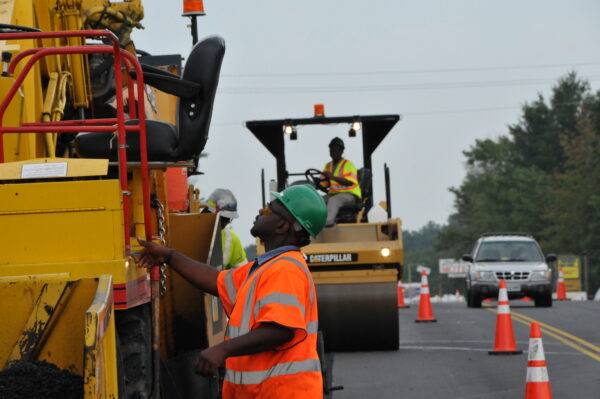
ITCPs are coordinated plans for roadway construction sites designed to protect workers on foot, aka “pedestrian workers,” who labor in close proximity to large vehicles and equipment, often adjacent to the motoring public.
Pedestrian workers are especially vulnerable for a variety of reasons:
• Construction vehicles and equipment have blind spots.
• Workers can get complacent when frequently near equipment, tuning out backup alarms.
• Operators and drivers are concentrating on their own tasks and may not be looking for pedestrian workers.
Other challenges include workers crossing the path of large dump trucks; equipment entering or exiting the work area; and workers taking shortcuts to latrines, rest areas, and parking areas.
ITCPs help separate workers on foot from the pathway of trucks and equipment. People are trained not to enter vehicle routes, except as planned and vehicle and equipment operations are planned and controlled to minimize or eliminate backing up. ITCPs also help coordinate the location of water coolers, latrines, employee parking, and break areas to help ensure workers are not “enticed” to cross vehicle pathways.
Phillip Russell, a veteran labor attorney with law firm Ogletree Deakins advises, “Employers who want to both improve safety and keep the Occupational Safety and Health Administration away should seriously consider implementing a robust ITCP. Even if tragedy strikes, it is important for employers to show they did all they could to provide a safe jobsite, including many of the elements of an ITCP.”
ITCPs are not new; in fact, they have been around for over 20 years. They are gaining wider acceptance today because the construction industry has a better understanding of them. They are growing in popularity because they function to prevent injuries and death while also streamlining construction operations by planning and controlling vehicle and worker interactions. The planning required to develop ITCPs can also streamline operations to create a more efficient site.
“Internal Traffic Control Plans provide a structured framework for managing construction traffic flow and ensuring the safety of workers, pedestrians, and motorists alike,” explains Mandy Kustra, safety director for Ajax Paving Industries of Florida. “By clearly outlining truck routes, the placement of flaggers, the location of construction equipment, and the presence of workers on foot, the risks associated with construction activities can be significantly reduced, ultimately leading to a safer working environment for all involved.” Ajax has pioneered the use of ITCPs in Florida for nearly a decade.
ITCPs may be extensive and planned well ahead of scheduled work or drafted on a clipboard at the beginning of each shift. The most important element is simply communicating the plan with workers, drivers, and operators.
Travis Parsons, director of occupational safety and health at the Laborers’ Health and Safety Fund of North America agrees. “Effective communication is crucial in road construction projects, and ITCPs play a key role in this process. These plans are essential for contractors to convey safe movement protocols to workers during pre-construction meetings and daily safety briefings,” said Parsons.
Just like a traditional traffic control plan keeps motorists safe, ITCPs help mitigate risks, minimize disruptions, and maintain a secure environment for workers and the public on construction jobsites. Knowing where to be, and most importantly where not to be, can save lives.
Related News

Bridging the Gap: Risk Management for Critical Infrastructure in Wake of Baltimore Collapse
by Jason Miles, P.E., project manager, Modjeski and Masters The recent collapse of…
A Simple Solution to Dangerous Highway Debris
by John Schneidawind, ARTBA vice president of public affairs, and Beth McGinn, ARTBA…
A “Hail Mary” For a $4 Billion Virginia Transportation Project
by John Schneidawind, vice president of public affairs, ARTBA With a long, painful moan…