
by Bradley Sant, senior vice president for safety and education, ARTBA
As I write this article, a dangerous “heat dome” is settling over the western half of the United States. Temps in several states will top out at 20 to 25 degrees above normal and it is only the first week of June.
This is also the time of year when transportation construction crews are at their busiest. A convergence of more people laboring in the heat, and hotter than average weather can be a dangerous recipe if workers and supervisors are not properly prepared.
Last year, the Occupational Safety and Health Administration (OSHA) announced employers may soon be required to have a Heat Illness and Injury Program (HIIP) to train their people about heat-related hazards. For example, there are about two dozen different signs and symptoms workers need to be on the lookout for—including headache, dizziness, confusion, and nausea.
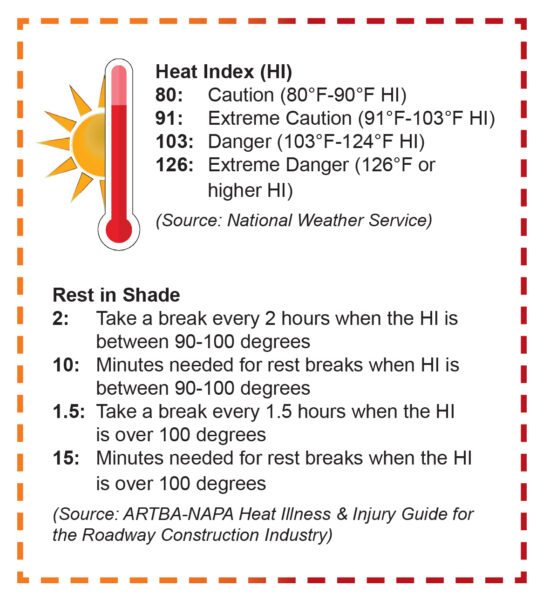
One of the most important things workers can do to prevent heat-related illness is acclimatization—slowly adjusting the duration one spends in the heat. New employees whose bodies have not had time to adjust to working in the heat are most vulnerable. Nearly three out of four workers who die from heat-related causes die in their first week on the job. Acclimatization is achieved in most people within four to 14 days of regular work for at least two hours per day in the heat.
OSHA says it is once again planning enhanced enforcement actions, with a strategic focus on geographic locations and industries where high heat impacts vulnerable worker populations. This means more inspection activity as well as a broader use of enforcement tools.
To help our member firms comply with OSHA’s directive and keep their workers safe during these hotter than average months, ARTBA and the National Asphalt Pavement Association teamed up to create a customizable HIIP specific to the roadway construction industry. These free resources have all the numbers you need to help your crews stay safe this summer. Visit artbasafetycenter.org for more information.
Related News

Bridging the Gap: Risk Management for Critical Infrastructure in Wake of Baltimore Collapse
by Jason Miles, P.E., project manager, Modjeski and Masters The recent collapse of…
A Simple Solution to Dangerous Highway Debris
by John Schneidawind, ARTBA vice president of public affairs, and Beth McGinn, ARTBA…
A “Hail Mary” For a $4 Billion Virginia Transportation Project
by John Schneidawind, vice president of public affairs, ARTBA With a long, painful moan…