
by John Schneidawind, vice president of public affairs, ARTBA
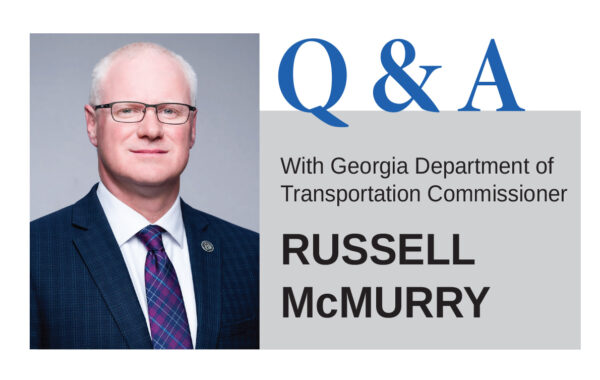
Russell McMurry, P.E., commissioner of the Georgia Department of Transportation (GDOT), runs the nation’s 10th largest state transportation system, with an operating budget of more than $4 billion and nearly 3,900 employees. McMurry began his career in 1990 as an intern working in construction and had several roles prior to being named chief engineer. He was named GDOT planning director by then Gov. Nathan Deal (R) before being appointed commissioner by a unanimous vote of the State Transportation Board in 2015.
Georgia’s economy continues to boom as foreign automakers open new plants. Hyundai is spending $5.5 billion on a huge electric vehicle plant near Savannah that is already in production and will employ 8,100 people.
With such growth comes transportation infrastructure challenges. McMurry spoke with ARTBA Vice President of Public Affairs John Schneidawind about how Georgia’s economic expansion has spurred road and bridge construction in the Peach State, and how 2021’s Infrastructure Investment and Jobs Act (IIJA) is indispensable to that effort. Here’s an edited transcript of the interview:
Q: Can you describe the major challenges you’re facing as Georgia DOT commissioner?
A: We’ve been making strategic investments going back to 2015, when there was state legislation passed that basically added $1 billion to GDOT’s budget. Those dollars were foundational. At that point our roadway conditions had degraded, our bridge conditions had degraded, and a significant investment had not been made in literally 30 years. Since 2015, we’ve actually gained ground on the condition of our assets. If you look at the nation, we’re maybe a little better than some on roads and bridges. But we have to continue to invest because Georgia is just growing so fast.
Q: Now that we’re in year-three of the IIJA, how have the historic levels of new federal investment helped shape your state’s program?
A: I have been saying for years now that the IIJA is like the Charles Dickens classic, A Tale of Two Cities. It’s the best of times; it’s the worst of times. It is truly the most historic transportation investment that our nation has ever seen. At $1.2 trillion, it’s obviously a huge investment across all modes, which is wonderful and was desperately needed. And that’s the best of times.
It’s also sort of the worst of times… increased cost has affected our program. We’ve seen really rising costs over the last two-and-a-half years that have met or outpaced the increase in federal funding to our formula programs that each state depends on.
Q: Has inflation taken a big bite out of your transportation budget?
A: The reality is that increased costs have eroded that buying power. What I say is it has kept our head at water level. On some projects, we have gone below water and on some projects, we come up for a breath of air. In fact, our data looking back to the end of calendar year 2020 into October 2023, we’ve seen asphalt resurfacing projects in Georgia increase by 80 percent. Bridge costs during that same time—just for the bridge, not ancillary items like roadway approaches—have increased by 61 percent per square foot.
And if we’re taking a two-lane lane to a four-lane or five-lane roadway in Metro Atlanta over that same time, costs have increased by 118 percent.
The timing with Congress passing the IJA was just amazing because I cannot imagine what situation we would be in Georgia without it—or the nation for that matter. We haven’t lost ground, which we absolutely would have otherwise.
Q: What role does alternative delivery play in your program and how do you see these methods developing in your state?
A: Alternative delivery is one of many tools in our toolbox, and we have been doing design build for a very long time and continue to do different iterations of it. We have now done several design build finance projects, where we size the finance—being short term or commensurate with the burn rate of the money—so that the contractor does not have to finance the project. We’re able just to pay commensurate with the pay schedule in the contract. That way we can contract and not tie up so much money initially. We can be a little more strategic with the use of our money.
We’ve had some bigger design build finance interchange projects that were somewhere between $700 million to over $1 billion. We’ve got three of those. One of them is just finishing up, one is in procurement, and one is under construction—where we’ll pay the developer and design build team back, over three-to-four, or maybe three-to-five-years after it opens to traffic.
Q: As you know, we’re already gearing up for the next big transportation reauthorization in 2026. What would you like to see changed as we move forward? What lessons are we learning?
A: There needs to be a careful analysis of discretionary programs. I understand discretionary programs will always have a place in federal programs, but I just think it’s all about being able to effectively deliver projects to the public no matter what type they are. If it’s transit, surface transportation, aviation, rail, or waterways, it’s all about getting the infrastructure delivered. I just feel that I’ve seen too many fits and starts with discretionary funding—in not having projects vetted initially. We lose a lot of time.
Looking at reauthorization, we’ve got to message that the ‘once in a generational investment’ can’t be just a ‘once in a generational investment.’
Related News

Vicki Kramer Has Clear Transportation Goals for the Cornhusker State
by John Schneidawind, vice president of public affairs, ARTBA Vicki Kramer was appointed…

“From the Bronx to Buffalo”
by John Schneidawind, vice president of public affairs, ARTBA Marie Therese Dominguez has…

A Transportation Veteran Takes On His Biggest Challenge
by John Schneidawind, vice president of public affairs, ARTBA Paul Wiedefeld is no…