

Testimony Presented to the House Committee on Natural Resources
Anthony P. Boals, P.E., Vice President, Wright Brothers Construction Company on behalf of the American Road & Transportation Builders Association
Chairman Westerman, Ranking Member Huffman and members of the committee, thank you for convening today’s hearing.
I am Tony Boals, vice president of Wright Brothers Construction Company, a family-owned heavy civil construction company headquartered in Charleston, Tennessee, that employs more than 400 men and women and has completed transportation infrastructure projects across the Southeast. I am testifying on behalf of the American Road & Transportation Builders Association, established in 1902 and the only national association representing all aspects of the transportation design and construction industry.
Transportation improvements and environmental stewardship are not mutually exclusive. In fact, their synergy can yield significant benefits, such as reduction in traffic congestion; protection of wetlands and waterways; and improved environmentally focused design.
The transportation construction industry supports the role of federal permitting in delivering environmentally responsible infrastructure projects that improve the lives of all Americans.
At the same time, inefficiencies in the federal permitting process can hamper the delivery of transportation system improvements by creating avoidable project delays that add cost and time to construction. We appreciate the committee convening a review of the National Environmental Policy Act (NEPA) and look forward to being part of an ongoing dialogue about how to improve the application of this critical law to “encourage productive and enjoyable harmony between man and his environment.”
The objectives of the federal transportation program—to support a national network that enables the safe and efficient movement of people and goods—can be at odds with the NEPA process. Projects that make getting kids safely to after-school activities or parents home from work faster have been delayed for years by lawsuits from third parties..
These delays cost time and money, but more importantly deny critical transportation enhancements that benefit the American public. This was not why NEPA was established.
Today I will share the perspective of the transportation construction industry on the dynamic between projects and permitting and offer suggestions to make the process work to the benefit of all parties. We believe, with common sense process reforms, we can construct projects quicker without compromising important environmental safeguards.
Transportation Construction and Environmental Stewardship
The transportation construction industry has a long track record of undertaking voluntary conservation efforts. From utilizing recycled asphalt on roadway improvements to proactively engaging in voluntary conservation efforts, our industry embraces the responsibility to preserve the communities where we live and work.
At Wright Brothers, our commitment to stewardship is evident through our company’s actions. Our employees undergo training related to stormwater management, erosion prevention, and sediment control, specific to the ecology and geography where they operate. They are educated on the environmental permitting process and the role of government agencies with the intent of creating a base of knowledge across our operations about the importance of conservation.
We’ve completed projects that demonstrate our responsibility to the environment not because a government entity is directing us to, but because it is the right thing to do. For example, in Bradley County, Tenn., Wright Brothers worked with the Army Corps of Engineers to transform land that had previously been used by cattle into a vibrant wetland.
The transportation construction industry is constantly looking for new ways to innovate and get projects moving with the underlying understanding that our work should respect and protect the environment.
NEPA in Action: Time is Money
A transportation improvement project often takes years from initiation of an environmental review to the ribbon cutting of a finished roadway or bridge. NEPA reviews require federal agencies to assess the environmental impacts of transportation projects, such as potential effects on air, water, and local wildlife. These reviews also require evaluating different project alternatives, including the possibility of not proceeding. The opportunity for public input is also mandatory during various stages of the process.
While efforts have been made to improve the preparation of Environmental Impact Statements (EIS), the time required continues to be measured in years rather than months. According to a January 2025 report from the White House Council on Environmental Quality (CEQ), the current average completion time for an EIS across all types of projects is still nearly double the federal requirement of two years. For transportation improvements, the average is even higher, as these often face longer timelines for environmental review.
In addition to NEPA, safety and mobility improvements are subject to the Endangered Species Act, Clean Water Act, Clean Air Act, National Historic Preservation Act, and other regulations related to public lands and noise via the Federal Highway Administration (FHWA). Each of these may require lengthy permit reviews before projects can move forward or can trigger litigation hampering project progress, regardless of NEPA status.
This complex web of permits often requires duplicative paperwork and puts significant strain on state and local resources, as they—not the federal government—are required to assemble the materials needed for reviews. While federal policy aims for a two-year timeline to complete these reviews, states are not provided additional resources to complete their process faster, regardless of the federal standard. Giving states flexibility to dedicate more resources to NEPA reviews could help address this.
As a contractor, I am frankly grateful not to be directly entangled in this web of NEPA red tape. However, as a taxpayer, I am concerned that this process is needlessly complex, resulting in time and money wasted that could be spent building projects.
Wright Brothers is typically not involved in a project until after the permitting and NEPA process is complete. From there, a project can go out to bid and the design and construction phase can begin, though the NEPA process is not always linear.
In cases where litigation is initiated after a NEPA decision has been made and construction has begun; contractors are often faced with employees unable to work and equipment gathering dust if a work stoppage is ordered by the courts.
To highlight the time-consuming nature of the permitting process, the following project examples underscore the significant time and resources that can be required to complete the NEPA process:
In Arkansas, FHWA and the Arkansas Department of Transportation (DOT) were required to produce a supplemental EIS to extend Interstate 49, a high-priority corridor, stretching from Shreveport, Louisiana to Kansas City, Missouri. The initial EIS for this project was completed in 1997; however, the agency was required to issue a supplemental review following project design changes, public consideration of tolling, and minor changes to other aspects of the project.
Now, nearly 30 years after the completion of the initial EIS, the design is finally getting underway and moving to bid.
In Syracuse, New York, the Interstate 81 viaduct project is also illustrative of the complicated and unpredictable permitting landscape. New York began exploring plans to replace an outdated viaduct in 2008, commencing with a five-year study of area needs and options. Over the next nine years, the state conducted an extensive environmental review, and three options were assessed to re-route the viaduct.
Shortly after the EIS was released, a lawsuit was filed, claiming the environmental review was “illegal, arbitrary and capricious.” For the next two years, the project faced delays and uncertainty before the plaintiff dropped the suit against FHWA late in 2024.
In Portland, Oregon, the I-5 Rose Quarter Improvement Project began its environmental review process in 2022. The project was designed to reduce congestion along a heavily traveled corridor. After completing the required reviews, a lawsuit was filed in 2024 alleging that the agencies erred in issuing an Environmental Assessment (EA) and should have prepared a more rigorous Environmental Impact Statement (EIS) instead. As a result, progress has stalled, and the project remains in limbo while the litigation continues.
Meanwhile, as evidenced in the chart below, labor and materials costs increase over time, in turn increasing the estimated cost of a project. These cost increases constrain states’ ability to maximize investment of taxpayer dollars and ultimately result in fewer improvements to communities.
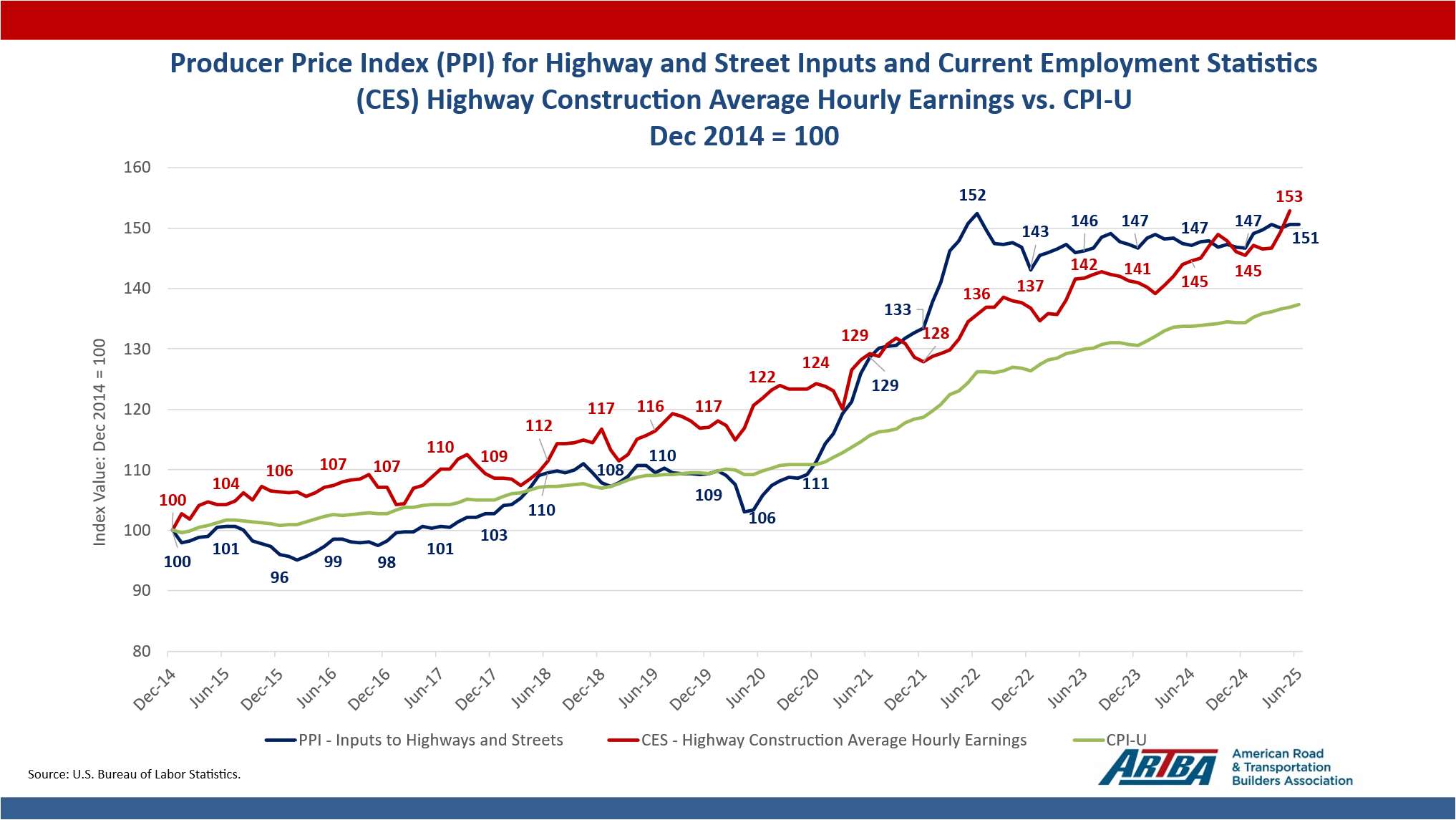
Contractors are often stuck on the sidelines as litigation and lengthy permitting reviews play out. For an industry that relies on certainty to invest in people and equipment, these delays erode confidence and increase risk to the contractor, which can lead to increased project costs.
Further, project owners look to the certainty of long-term surface transportation bills to ensure funding is available to advance major projects. NEPA and associated environmental reviews can often take longer to complete than a typical reauthorization bill’s lifespan, which may call into question whether or not the federal funds will be present when a project is ready to go out for bid.
The fluctuating regulatory environment that comes with administration changes also leads to uncertainty. For example, during President Trump’s first term, his administration posed much needed reforms to NEPA regulations, which were subsequently rolled back by the Biden administration. These reforms are now being proposed again, alongside new changes. Meanwhile, projects continue moving through the environmental review process—even as the ground beneath them keeps shifting—creating uncertainty about the process required to move a project from concept to construction.
Congressional action to codify recent NEPA reforms would help alleviate the pendulum swings inherent in the political process that create uncertainty and increase costs, while diluting limited federal resources.
Recent Progress Across the Government
Each branch of government has recently taken action that could dramatically improve the NEPA process and get transportation projects moving forward.
The Trump administration’s aforementioned proposed regulations aim to return NEPA to its original intent— merely a procedural statute that assesses the environmental impacts of projects. By moving the responsibility away from CEQ to the individual agencies, including the U.S. Department of Transportation, agencies can better avail themselves of their individual resources and lead agency authority, enabling more timely completion of reviews.
Bipartisan congressional action in 2021 to codify One Federal Decision (OFD) also has the capacity to make the NEPA process more predictable. By designating a lead agency, establishing page limits and timelines, the average time for completing an EIS could be significantly reduced—if the law’s requirements are enforced.
The recent Supreme Court decision in Seven County Infrastructure Coalition reaffirmed Congress’s original intent that NEPA is a procedural statute—not a tool to dictate project outcomes. The unanimous ruling highlights how NEPA can be used as a barrier to infrastructure development and underscores the opportunity for a long-overdue course correction. The Court clarified that NEPA reviews are limited to the time and place of the project in question and do not require agencies to evaluate speculative or unrelated indirect impacts.
Taken together, the actions across all three branches of government
Making NEPA Work for All Parties
More than five decades of NEPA activities have revealed clear opportunities to make the process more efficient, accountable, and responsive—without sacrificing environmental protections. Congress should consider legislation to enact the following reforms:
Encourage NEPA Assignment: NEPA assignment allows states to take on the role of managing environmental reviews. While all states are eligible to participate, only eight states have done so: Alaska, Arizona, California, Florida, Nebraska, Ohio, Texas, and Utah. States with NEPA responsibilities report faster permitting and review times, while maintaining adherence to established federal standards.
For example, California reports shaving years off the environmental review process, despite having strict state level requirements. Utah has saved 9-11 months per review. Money is being saved in Florida and Ohio, each reporting tens of millions in annual savings. Taken together, this time and money saved can give states the ability to do more with their limited resources.
To help more states take on NEPA responsibilities, Congress should:
- Make NEPA assignment permanent after an initial five-year audit,
- Standardize paperwork and application requirements, and
- Allow federal resources to be used to cover recipient costs for completing NEPA reviews.
Narrow Judicial Review: Under current FHWA NEPA regulations, legal challenges must be filed within 150 days only if a limitation of claims notice is published. Without one, the statute of limitations can extend up to six years—meaning lawsuits can be filed long after a project has started or even been completed. This legal uncertainty undermines project delivery and increases financial and planning risks. In some instances, these lawsuits are simply meant to halt projects by their opponents and the lawsuits are later dismissed for lack of merit. To promote predictability and finality, Congress should establish a uniform 120-day limit for all NEPA lawsuits, without the requirement to file a notice. In addition, standing should be limited to parties who provided substantive comments during the public review process, ensuring that only those who meaningfully engaged with the process, and have a legitimate claim can pursue legal action.
Strengthen One Federal Decision (OFD): Codified in the Infrastructure Investment and Jobs Act (IIJA) and reinforced by the Fiscal Responsibility Act, each with bipartisan support, OFD requires the designation of a lead agency to coordinate environmental reviews and mandates that major projects be tracked on a public permitting dashboard to enhance transparency. However, despite this statutory framework, many projects continue to experience delays due to inconsistent agency coordination, limited accountability, and missed target timelines.
To fully realize OFD’s potential, additional steps are needed to improve interagency discipline and ensure timely, predictable environmental reviews, including:
- Requiring federal agencies to take full responsibility for meeting established NEPA deadlines. This will eliminate burdens on project owners—such as state DOTs— and help reduce time and money spent on “pre-NEPA” activities,
- Streamlining document requirements by focusing on actionable information that reduces redundancies and supports decision-making limited to:
- A clear statement of project purpose and need,
- A focused analysis of significant environmental impacts,
- A concise comparison of reasonable alternatives,
- Necessary mitigation measures only when applicable to other environmental reviews, and
- A summary of public input and responses
- Eliminating barriers to OFD by expanding coverage to environmental assessments (EAs),
- Expanding categorial exclusions (CE) by raising the project cost threshold from $5,000,000 to $10,000,000 to allow more projects to qualify.
Modernize NEPA: Encouraging states to use digital technologies to conduct NEPA analysis will facilitate greater collaboration and support productivity improvements between agencies.
An Efficient NEPA Process Benefits All
As a contractor committed to building infrastructure responsibly, I understand the need to balance progress with protection. NEPA plays a vital role in safeguarding our natural and cultural resources—but just like I am constantly trying to refine and adjust my business to reflect our changing world, our regulatory structure can always be improved.
Common-sense reforms that streamline reviews, increase accountability, and reduce unnecessary delays will help ensure federal dollars are spent building infrastructure, not navigating red tape. With thoughtful action from Congress, NEPA can work better for all parties—delivering both environmental stewardship and timely project delivery.
The transportation construction industry is ready to work with Congress in its efforts to modernize NEPA in a way that honors the law’s purpose, while meeting the urgent infrastructure needs of the 21st century.
Thank you for your time and consideration, and I look forward to your questions.
Related Resources
Congressional Testimony: Examining the U.S. Department of Transportation’s Regulatory and Administrative Agenda
Testimony Presented to the House Subcommittee on Highways & Transit Tim Duit, President,…
Congressional Testimony: IIJA Implementation
ARTBA Chair Paula Hammond’s (WSP USA) testimony before the U.S. House Highways & Transit Subcommittee.
Putting the Bipartisan Infrastructure Law to Work: The Private Sector Perspective
ARTBA President Dave Bauer’s testimony before the U.S. Senate Environment & Public Works Committee.