
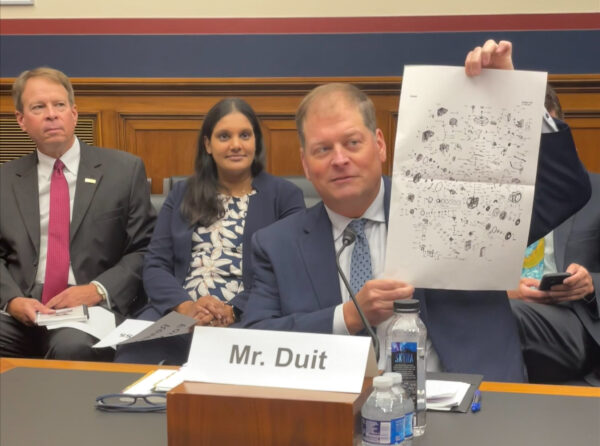
Testimony Presented to the House Subcommittee on Highways & Transit
Tim Duit, President, Duit Construction Company, Inc., 2024 ARTBA Chair
Subcommittee Chairman Crawford, Ranking Member Norton, and members of the subcommittee, thank you for convening today’s hearing.
I am Tim Duit, president of Duit Construction, a heavy highway concrete and asphalt construction company with more than 700 team members that is based in Edmond, Oklahoma. I also serve as the current chair of the American Road & Transportation Builders Association (ARTBA).
Established in 1902, ARTBA is the only national association representing all aspects of the U.S. transportation design and construction industry. Our 8,000 members, anchored by our 36 state contractor chapter affiliates, design, build, and manage the nation’s transportation infrastructure.
Today’s hearing offers an opportunity to examine the balance between the work required to construct and maintain America’s roads, bridges, and public transportation systems and the regulatory safeguards under which the transportation construction industry operates.
These safeguards aim to protect workers and the traveling public, provide a level-playing field for businesses to compete, and ensure stewardship of the environment and national transportation system.
A robust regulatory framework and a strong national transportation system are not mutually exclusive.
The Infrastructure Investment and Jobs Act (IIJA) provided a much-needed boost in investment to support modernization of the multi-modal U.S. transportation network. My company has already experienced the impacts of this investment, winning multiple bids for projects supported by the infrastructure law. Oklahoma has seen more than 1,600 projects receive IIJA funding commitments, and Duit Construction has ramped up hiring and equipment purchases to accommodate the increase in activity for our company.
At the same time as the infrastructure law’s investments are supporting mobility and safety improvements, a maze of new and expanded regulations that govern the use of these funds is being advanced. The resulting uncertainty impacts how I hire, when my teams can begin construction, and where to purchase materials and equipment needed on jobsites.
As I noted at the outset, state and federal regulations have always been part of public sector infrastructure endeavors. Our goal is to ensure that the regulatory environment has the same objectives as transportation investments—to help move people and products in the safest and most efficient manner possible.
The Infrastructure Law So Far
A complex regulatory environment existed prior to the IIJA, and it’s important to underscore that any rulemakings underway since 2021 do not overshadow the significant impacts most states are seeing in work performed thanks to the law’s investment increases.
As the IIJA has crossed the mid-way point of its five-year authorization, its market impacts are evident at all stages of the highway and bridge construction pipeline, delivering safety improvements, upgrades, and enhancements that improve the quality of life for all Americans. There are very few government programs that have such a widespread and lasting impact on our country.
The map below depicts the number of new federal-aid highway and bridge project commitments in the law’s first two years—totaling more than 75,000 so far.
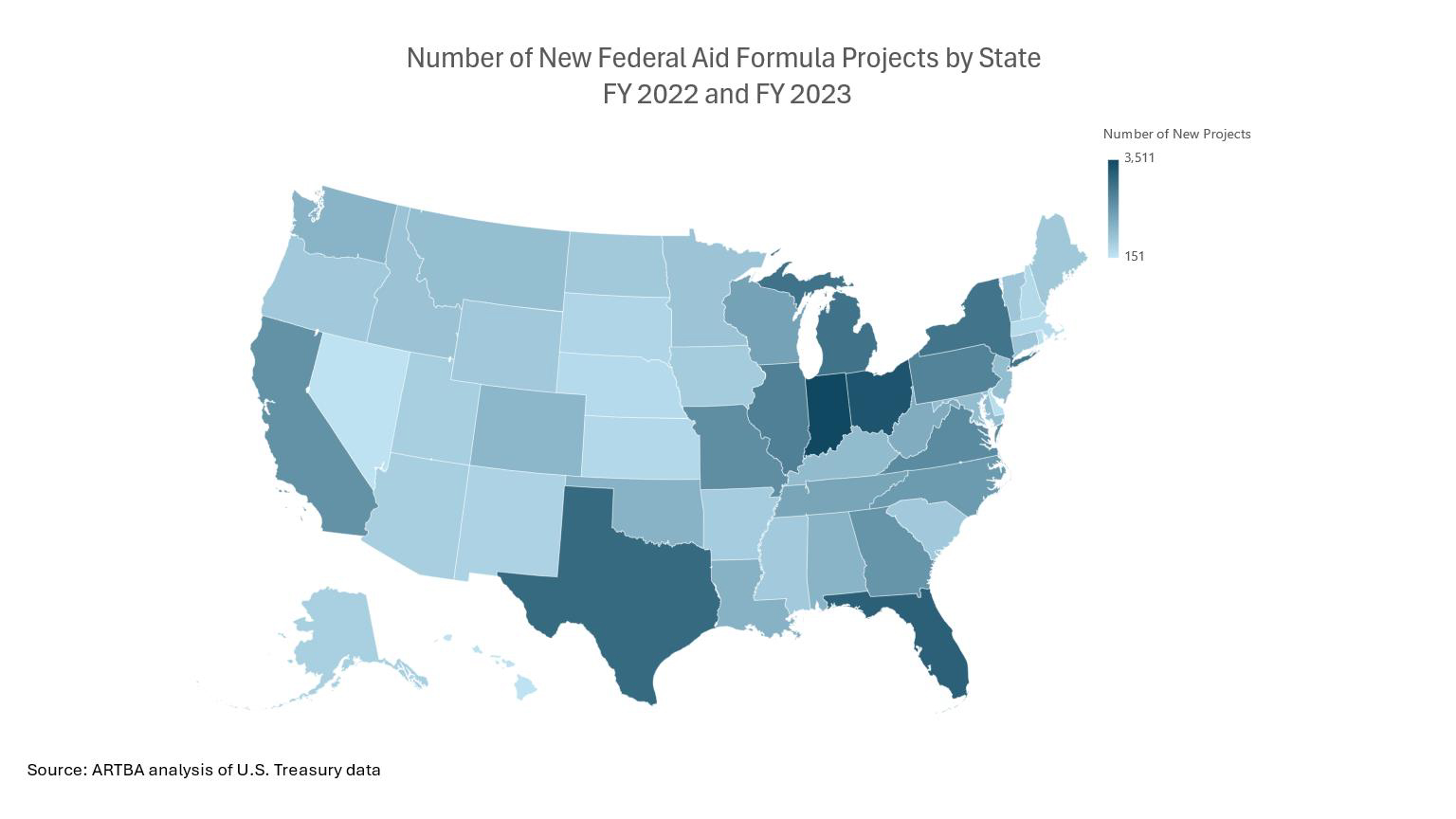
Additional indicators of the law’s progress since October 1, 2021, include:
- States have advanced at least one federal-aid highway and bridge project in nearly every county across the country;
- The value of state and local government projects breaking ground was up, year-to-year, 27 percent in 2022 and another 9 percent in 2023;
- The value of state and local government projects was nearly $114 billion in 2023, compared to $75 billion in 2019;
- Nearly 43,000 new construction industry jobs have been added since 2021; and
- The value of highway and bridge construction work is up over 18 percent in the beginning of 2024, on top of record levels of work in 2022 and 2023.
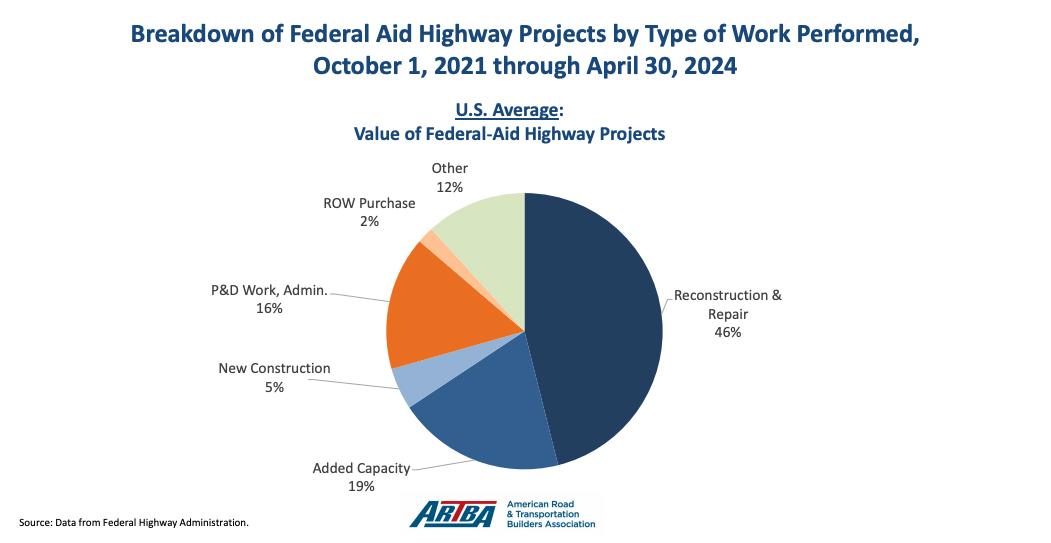
Projects supported by the infrastructure law include repair and reconstruction work, new capacity, planning and design, right of way purchases, and other eligible activities under the federal-aid highway program, as depicted in the chart below.
The law also supports major projects with a regional impact, such as the Anzalduas International Bridge project in Texas or upgrades to the I-10 freight corridor in Mississippi, along with important improvements at the local level, such as the reconstruction of Cedar Falls Main Street in Iowa and safety improvements on South McGregor Avenue in Mobile, Alabama.
Closer to home, Muskogee, Oklahoma, will see freight, safety, and community improvements thanks to a $74 million replacement of the east and westbound spans of the U.S. Highway 62 bridge over the Arkansas River. The 60-year-old bridge was showing major signs of wear and tear, and with the help of IIJA funding, the state is investing in the economic future of the region. Given the strength of leading indicators and stable funding, construction activity is expected to continue to grow in the next three years as highway and bridge improvements continue.
Transportation Construction and the Regulatory Environment
Federal regulations, when properly enacted, can foster market growth and competition, spur innovation, and ensure that safety and environmental stewardship run parallel with the cost-effective delivery of transportation infrastructure projects. However, when these regulations become overly burdensome, they have the potential to stifle infrastructure investment and shift costs from construction to compliance.
Government wide, 2024 has been one of the most-costly years for federal regulations finalized to-date. And since the enactment of IIJA, there have been at least 50 new regulations affecting the transportation construction industry alone.
Compliance costs such as rule familiarization, new paperwork, and recordkeeping requirements, as well as the need for increased staff and equipment, are exacerbated when businesses do not know how to comply with rules. As such, contractors competing to work on transportation improvement projects will often “price” the risk of new regulatory requirements—or uncertainty about them—into their bids, resulting in needlessly higher project costs for taxpayers.
These rulemakings have generated new uncertainties for the industry as they seek to properly comply, threatening to delay projects and increase costs. A cycle of a proposed rule, finalization, and in some cases, litigation, creates significant challenges for businesses large and small.
The following represents a cross section of recent regulatory activity in transportation construction that impacts how projects are delivered:
Contracting
The transportation construction industry seeks to maximize safety, cost-effectiveness, efficiency, and environmental stewardship in building federal-aid projects. The federal regulatory regime should not—and need not—compromise those objectives. Regrettably, several recent regulatory changes or proposals threaten to undermine economic benefits from the IIJA’s record investments.
Here are current examples of regulations which, when improperly interpreted and implemented, threaten to dilute the value of federal investment.
- Build America, Buy America
The “Build America, Buy America Act” (BABA), embedded in the IIJA, remains a significant implementation challenge as we approach three years since the law’s enactment. ARTBA supports the clear congressional intent to grow domestic manufacturing capacity in the long-term. Our concern relates to the potential for project disruptions, given unrealistic market expectations and the time required for domestic manufacturing capacity to develop.
For more than 40 years, Buy America has required a domestic manufacturing process for iron, steel and certain manufactured products permanently incorporated into federal-aid highway and transit projects, which ARTBA has supported. The IIJA expanded Buy America coverage to five categories of construction materials (non-ferrous metals, plastic and polymer-based products, glass, lumber, and drywall). The law also codified responsibilities for the Made in America Office (MIAO), part of the Office of Management and Budget (OMB) which the Biden administration had created by executive order. The MIAO is charged with coordinating domestic preference programs and reviewing related waivers for the entirety of the federal government.
ARTBA continues to see shortcomings and misplaced priorities in BABA’s implementation. In February 2024, ARTBA joined three other national associations in filing a petition for rulemaking with OMB. Our coalition contends that MIAO has wrested numerous responsibilities for BABA implementation from the Federal Highway Administration (FHWA), the Federal Transit Administration (FTA) and others with decades of experience in applying Buy America to projects. In some cases, this has resulted in uncertainties or inconsistencies in current Buy America requirements across states. Additionally, the petition notes that the BABA waiver process, in which MIAO now plays a critical role, has proven to be inconsistent, opaque, and dysfunctional for several agencies.
Also of great concern, FHWA has proposed rolling back its longstanding waiver for manufactured products. This action would result in significant administrative costs and delays, in part because contractors will need to document the origin of small, inexpensive, commercially available, off-the-shelf items that comprise various manufactured products.
In a survey of contractors undertaken in response to FHWA’s request for information on this topic, two-thirds of respondents anticipated the proposed rollback would require “significant additional time and cost to document and certify the components within manufactured products.” They also identified dozens of manufactured products—including electrical, electronic, and mechanical items—that would be difficult or impossible to procure at a reasonable cost—or at all—with enough domestic content to comply with FHWA’s proposed rule change.
We urge this committee to engage with OMB, MIAO, FHWA and FTA, and seek to minimize project cost increases and delays resulting from the BABA provisions.
- Disadvantaged Business Enterprise Program
In April 2024, the U.S. Department of Transportation (DOT) released rule changes for its longstanding Disadvantaged Business Enterprise (DBE) program. Conducted over two years, the rulemaking addressed almost 40 aspects of the DBE program, yielding approximately 400 comments to the docket.
ARTBA supported some of the rule changes and appreciated FHWA’s responsiveness to a number of our comments. However, since the May 9 effective date, the association has heard significant concerns from members—including DBE firms—as to how various new requirements are being interpreted at the state level.
This includes extensive data collection responsibilities, which some state transportation agencies appear poised to impose on contractors and subcontractors bidding on federal-aid projects. Some DBE firms have commented that these types of administrative mandates may drive them from the transportation construction market entirely.
ARTBA recommends that this committee deploy its oversight responsibilities to review various aspects of DBE program implementation under the revised rule.
- U.S. Department of Labor (DOL), Davis-Bacon Act Regulations
Last summer, DOL announced significant changes to the Davis-Bacon Act’s regulations that govern the prevailing wage for federal contracting. While DOL was responsive to and specifically referenced ARTBA’s comments, portions of the final rule remain problematic. Specifically, DOL’s revisions concerning truck drivers and materials suppliers created significant confusion for transportation construction contractors. Furthermore, DOL regional offices have not reported consistently on the rules.
Litigation has stayed the most problematic rule changes for the time being, but ARTBA notes that DOL’s implementation guidance has not been sufficiently detailed or timely (including updates needed since recent court actions). Ensuring consistent application of the rule will alleviate unnecessary confusion. Non-compliance with these regulations can result in substantial penalties, including fines and potential debarment from future federal contracts, underscoring the importance of clear and uniform guidance for the industry.
We have also seen systemic challenges in Davis-Bacon compliance unrelated to the recent rule changes. For about the past fifteen years, job classifications and territories for calculating prevailing wage rates in Oklahoma have grown steadily, adding administrative costs. Congress or DOL should seek to streamline this process, which will reduce project costs and lead to more economic benefits from federal transportation investment.
- Fish and Wildlife Service (FWS), Migratory Bird Treaty Act (MBTA)
In a forthcoming proposed rule change, FWS is expected to further tighten penalties for accidental harm to migratory birds. While well-intentioned, this approach does not recognize that these species’ habitats can appear on transportation project sites (especially bridges) virtually overnight as birds build new nests. Broadening interpretation of the MBTA would likely require industry professionals to utilize extraordinary, costly and time-consuming measures to avoid accidental harm to, or takings of, any such birds, potentially requiring work stoppages. Moreover, if unintended incidents occur despite preventative steps, the contractor would be subject to an economic penalty. While contractors make significant efforts to protect wildlife on or near project sites, use of the MBTA in this way will diminish the predictability of workflow and costs.
Procurement
- Federal Highway Administration, Qualifications Based Selection Rule
Contracts for architecture and engineering services that are related to a construction project and utilize federal funding must foster open competition under the 1972 Brooks Act. This is achieved through a current FHWA procurement process known as “qualifications-based selection” (QBS), which assesses engineering design services based on demonstrated competence and qualifications for services being procured, all while ensuring a fair and reasonable price.
FHWA proposed eliminating the requirement to use the QBS method for projects awarded directly to a non-state agency (e.g., local, or municipal agency). ARTBA strongly opposes this proposal, as it could lead to suboptimal project outcomes by prioritizing cost over quality. High-quality engineering and design services are crucial for ensuring the safety, durability, and efficiency of transportation infrastructure. ARTBA is also concerned FHWA’s proposal would create an uneven playing field with QBS applying to some recipients and not others, without a substantive justification.
Project Delivery
ARTBA members have consistently demonstrated innovation and environmental stewardship, with many achieving significant sustainability successes through environmentally conscious project delivery methods. However, agency overreach and policy ambiguity create significant obstacles, and jeopardize the certainty required to advance transportation improvement projects.
- Federal Highway Administration, Greenhouse Gas Performance Measure
FHWA finalized a December 2023 rule requiring state departments of transportation (DOTs) and metropolitan planning organizations to establish greenhouse gas (GHG) emissions targets. While FHWA did not mandate specific targets, it required that emissions decline over time, as measured by tailpipe carbon dioxide data. This would apply to all mainline highways and public roadways.
ARTBA is not opposed to the reduction of GHG emissions in principle, but believes FHWA lacks the statutory authority, environmental expertise, and enforcement ability to enact such regulations. In fact, Congress deliberately contemplated and excluded such provisions from the IIJA. Further, this rule could impinge on state flexibility to select projects.
Twenty-two states challenged the rule in two federal district courts, and ARTBA filed an amicus brief in support of the challenge. Both courts ruled that FHWA does not have statutory authority, and the agency is now appealing, thereby prolonging the regulatory uncertainty under which ARTBA members operate.
- U.S. Environmental Protection Agency/Army Corps, Waters of the United States
Determining what constitutes Waters of the United States (WOTUS) under the Clean Water Act (CWA) is a perennial dilemma in Washington, D.C., and on construction sites around the country, given the shifting definitions proposed in various rulemakings over the last few years. For transportation construction professionals, roadside ditches have historically been exempted under WOTUS, but recent U.S. Environmental Protection Agency (EPA) action has created ambiguity.
The U.S. Supreme Court decision in Sackett v. Environmental Protection Agency clarified the scope of the CWA and sought to reduce regulatory ambiguity by providing a clear standard. Despite the Court’s directives, EPA finalized a new rule that made only marginal improvements, while perpetuating longstanding uncertainties in CWA jurisdiction.
While the agency removed the term “significant nexus” as instructed by the Court, EPA failed to provide a clear standard for “relatively permanent” water flow in the rule, leaving regulated individuals to determine this on their own and bringing in further compliance uncertainty. This resulting lack of clarity forces project proponents to determine WOTUS on a case-by-case basis, leading to delays and potential agency overreach.
Given that CWA violations carry criminal penalties, it is crucial for all regulated parties to understand what constitutes a WOTUS. ARTBA has requested implementation guidance from EPA to help achieve greater clarity and urges this committee to press the agency to issue draft implementation guidance for public comment.
- Permitting and National Environmental Policy Act (NEPA) Regulations
The IIJA introduced “One Federal Decision” (OFD) reforms, exemplifying a bipartisan spirit for improving and expediting environmental reviews. Currently, the approval process for new, major federal-aid transportation projects averages five to seven years, with some ARTBA members waiting as long as 14 years.
OFD aims to improve environmental reviews by enacting page limits, setting a two-year goal, and allowing federal agencies to engage in concurrent review. The IIJA made OFD a goal, and 2023’s Fiscal Responsibility Act strengthened OFD reforms into a requirement. To date, ARTBA cannot point to any tangible applications of OFD. Failing to implement these reforms can incur significant taxpayer costs, as projects take longer to move to the construction phase.
Separately, the White House Council on Environmental Quality (CEQ) earlier this year finalized phase two of its NEPA rulemaking. The rule was responsive to ARTBA’s comments by excluding prior greenhouse gas emissions guidance, but unfortunately removed references to the procedural nature of NEPA permitting, allows for indefinite extensions and requires consideration of abstract, hard-to-measure factors. ARTBA members have concerns that these ambiguities may lead to extended project delays and increased spurious litigation risks from third parties.
Efficient project delivery is vital to achieving the infrastructure renewal goals of the IIJA, and all parties must work in concert to achieve this, while protecting environmental safeguards.
Work Zone Safety
Safety for workers and the public is the top priority for ARTBA’s membership. ARTBA has a strong working relationship with the U.S. Occupational Safety and Health Administration (OSHA) and respects the core purpose of the agency to ensure the safety of workers and worksites.
Regrettably, current regulatory policies from OSHA have expanded from its core objective. This is particularly concerning in the context of safety, where clear and effective regulations are crucial to protecting these vulnerable workers.
- Occupational Safety and Health Administration, Worker Walkaround
Historically, an employee—and when necessary and justified a relevant expert—could accompany an OSHA inspector during jobsite inspections. Recently, OSHA expanded this rule, allowing any third party to accompany an inspector if deemed “reasonably necessary,” removing the requirements for good cause and specific expertise.
The previous, longstanding rule enumerated examples of qualified individuals, such as industrial hygienists or safety engineers. Instead, a third party can join an inspection if deemed “reasonably necessary” by the inspector, who has broad discretion to decide based on factors like relevant knowledge and communication skills. This expanded eligibility also includes individuals with prior relationships with employees.
In the transportation construction industry, the expanded rule could have several impacts. Union representatives might access non-union worksites for unauthorized organizing. Employers may face increased risks and liabilities if a third party is injured on an active site, especially if they are unfamiliar with proper safety protocols.
Third parties with ulterior motives might gather information for litigation, while their overall presence could distract employees and, once again, compromise safety. There are also privacy concerns about exposing proprietary information. Additionally, inspections could lead to operational delays and increased project costs.
OSHA claims this rule provides clarity, but it opens a door to new, undefined individuals and may result in delays, complications, and legal risks. Congress should require OSHA to remove this recent update to its regulation.
- Occupational Safety and Health Administration, Heat Safety Standards
OSHA announced a July 2, 2024, proposal to establish heat safety standards in indoor and outdoor settings. Despite comments from ARTBA and others urging OSHA not to enact a one-size-fits-all rulemaking, the agency is proposing to set nationwide heat triggers. ARTBA proposed OSHA adopt regional approaches, as workers in different settings are acclimatized to different temperatures.
ARTBA urged OSHA to allow employers to continue to implement the practices that best suit their employees, rather than requiring broad, prescriptive methods to address potential heat illness issues. Heat is not a new hazard for the transportation construction industry, and OSHA’s rule fails to account for the unique nature of the transportation construction industry, like the need for continuous activity during certain paving work. ARTBA members employ the most innovative and effective methods available to protect their workers, and OSHA’s proposal may detract from jobsite safety and effective project delivery with its combination of prescriptive break times and burdensome recordkeeping.
- Federal Highway Administration, Highway Safety Improvement Program
Approximately 900 fatalities occur in and around transportation construction worksites annually, and as many as 200 are roadway construction professionals. Ensuring a safe workplace for the thousands of professionals tasked with delivering mobility and safety enhancements envisioned by the IIJA is ARTBA’s top priority.
As thousands of new projects are initiated, there will also be an increased number of work zones, resulting in increased risk exposure for workers. The transportation construction community is committed to doing its part to mitigate an increase in the number of safety-related incidents.
FHWA’s Highway Safety Improvement Program (HSIP) rule is a well-meaning attempt to protect vulnerable road users but misses a key vulnerable group: roadway workers. The HSIP requires states to develop and implement strategic highway safety plans to reduce fatalities and serious injuries on all public roads. ARTBA has urged FHWA to explicitly recognize highway workers as vulnerable road users in all roadway safety initiatives. The health and well-being of workers who build and maintain transportation systems are not always fully considered by those who depend on them.
Roadway construction workers are not discretionary system users. They are required to be in work zones to aid the traveling public and support their families. They deserve the same prioritization as pedestrians and bicyclists.
Looking Ahead to 2026
Regulations should support, rather than hinder, the efficient and effective deployment of IIJA funds in the law’s remaining years. In support of that, ARTBA offers the following recommendations:
- Pass H.R. 8204, the Bipartisan Regulatory Early Notice and Engagement Act of 2024—this bipartisan legislation would increase transparency and engagement in the rulemaking process.
- Continued congressional oversight—a constant dialogue with federal agency officials on regulatory proposals is a valuable tool to ensure the law is implemented as Congress intended. This committee should continue to request testimony and updates from administration officials.
- Pursue additional reforms to enhance project delivery—the IIJA suggested a two-year goal for environmental reviews, which was strengthened in subsequent legislation to a requirement. Congress should consider additional policy reforms to streamline the permitting process and increase coordination among federal agencies.
- Provide agencies with clear directives in legislation—the U.S. Supreme Court’s overturning of the Chevron doctrine spotlights the crucial role of congressional leadership in ensuring that legislation is unambiguous, preventing regulations from ending up in litigation. ARTBA looks forward to its continued partnership with lawmakers to ensure that federal regulations are consistent with congressional intent.
- Timely engagement on reauthorization—a key driver for transportation construction investment is funding certainty to help states plan long-term investments. With the authorization of core surface transportation programs expiring in nearly two years, Congress should begin assessing current law and identifying priorities for timely enactment of a new, five-year law by October 1, 2026, including enacting revenue solutions for solvency of the Highway Trust Fund.
The federal role to develop and maintain a national transportation system is a responsibility enshrined in the U.S. Constitution that enables interstate commerce, supports the economy, and improves quality of life.
Thank you for the opportunity to share some of the practical impacts that a complex regulatory environment can have on the fulfillment of this responsibility.
ARTBA looks forward to collaborating with this committee to help ensure federal regulations work in concert with the delivery of a reliable and safe national transportation network for the nation.
Related Resources
Congressional Testimony: Restoring Common Sense to NEPA Reviews
Testimony Presented to the House Committee on Natural Resources Anthony P. Boals, P.E.,…
Congressional Testimony: IIJA Implementation
ARTBA Chair Paula Hammond’s (WSP USA) testimony before the U.S. House Highways & Transit Subcommittee.
Putting the Bipartisan Infrastructure Law to Work: The Private Sector Perspective
ARTBA President Dave Bauer’s testimony before the U.S. Senate Environment & Public Works Committee.