

Testimony Presented to the Committee on Environment and Public Works United States Senate
David Bauer, President & CEO, American Road & Transportation Builders Association
Chairman Carper, Ranking Member Capito, and members of the committee, thank you for convening today’s hearing. I am David Bauer, president and CEO of the American Road and Transportation Builders Association (ARTBA).
Established in 1902, ARTBA is the only national association representing all aspects of the U.S.
transportation infrastructure community. Our 8,000 members and 36 state affiliates own, manage, design, build and provide equipment and materials for all modes of transportation infrastructure improvements. The industry we represent generates $580 billion annually in U.S. economic activity and sustains more than four million jobs.
America’s network of roads and bridges is the foundation of the U.S. economy, delivering the national connectivity envisioned by the U.S. Constitution. The Infrastructure Investment and Jobs Act (IIJA), signed into law Nov. 15, 2021, enhances this vision, and was made possible by the remarkable leadership of this committee. For two consecutive Congress’, the Environment and Public Works Committee demonstrated that bipartisanship is still possible. The Surface Transportation Reauthorization Act of 2021, which was a precursor to the IIJA, embraced the nation’s mobility needs and crafted public policy to address them.
ARTBA has long advocated for federal leadership in the development and maintenance of a national transportation network to support continued U.S. economic growth and meet the public’s demand for safe and efficient travel.
IIJA in Historical Context
The IIJA should not be undersold as a half-measure, but rather as a down payment for the nation’s future. The five years of funding enabled by the infrastructure law will supercharge the long-term modernization of roads, bridges, airports, drinking water, and energy systems. Nearly half of the IIJA’s generational investment—nearly $450 billion—will be spent improving highways, bridges, and public transportation systems.
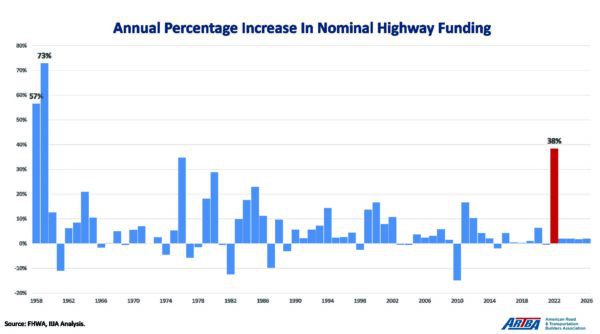
While some have argued the law does not provide meaningful increases in spending, the data proves otherwise. The increase in nominal highway funding is the largest in more than 50 years.
IIJA Highway and Bridge Investment Status
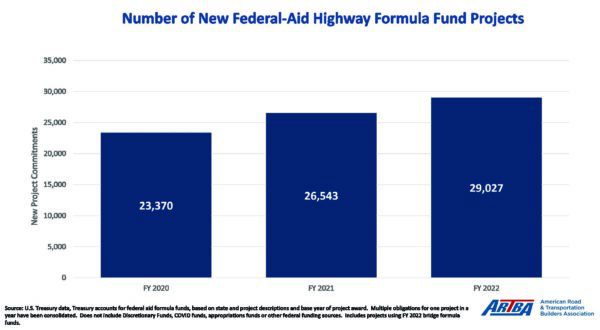
Today’s hearing is an important step toward providing transparency about how IIJA highway and bridge funds are being utilized. The good news is that state transportation agencies have initiated more than 29,000 improvement projects this year—2,500 more than in 2021. The chart on the following page highlights how states have obligated their FY 2022 highway and bridge funding and how many new projects these resources are supporting.
Thirty-seven states saw an increase in the number of federal-aid projects supported in FY 2022, and more large projects were advanced in FY 2022 compared to FY 2021. The number of large projects receiving federal support of $50 million or more increased by over 50 percent. This growth in large projects that received federal funds helps account for those states, like Texas, where the number of projects decreased following enactment of the bipartisan infrastructure law. In total, 105 projects across 29 states saw $50 million+ in federal investment compared to just 69 projects in 25 states in FY 2021.
| Federal-Aid Highway & Bridge Formula Fund Commitments and Spending
(as of September 30, in millions $) |
||||
| Value of Federal Highway & Bridge Program Formula Funds Committed | Number of New Project
Commitments |
|||
| State | FY 2021 | FY 2022 | FY 2021 | FY 2022 |
| Alabama | $810.9 | $958.7 | 618 | 581 |
| Alaska | $554.8 | $688.4 | 264 | 248 |
| Arizona | $805.7 | $960.3 | 269 | 290 |
| Arkansas | $557.4 | $775.3 | 246 | 349 |
| California | $3,511.1 | $4,702.1 | 970 | 925 |
| Colorado | $584.0 | $754.2 | 561 | 600 |
| Connecticut | $534.6 | $714.4 | 320 | 381 |
| Delaware | $185.4 | $250.0 | 111 | 120 |
| D.C. | $164.7 | $213.5 | 106 | 92 |
| Florida | $1,960.3 | $2,487.7 | 1,219 | 1,441 |
| Georgia | $1,370.5 | $1,862.3 | 770 | 897 |
| Hawaii | $198.5 | $290.0 | 81 | 95 |
| Idaho | $323.2 | $472.1 | 319 | 405 |
| Illinois | $1,507.6 | $2,001.2 | 941 | 1,220 |
| Indiana | $1,025.6 | $1,332.7 | 1,490 | 1,634 |
| Iowa | $525.5 | $677.4 | 224 | 266 |
| Kansas | $388.5 | $458.7 | 205 | 198 |
| Kentucky | $733.6 | $897.2 | 506 | 509 |
| Louisiana | $734.3 | $959.6 | 524 | 551 |
| Maine | $196.7 | $272.1 | 331 | 396 |
| Maryland | $589.2 | $627.5 | 455 | 454 |
| Massachusetts | $630.6 | $888.1 | 168 | 176 |
| Michigan | $1,136.8 | $1,460.3 | 1,069 | 1,252 |
| Minnesota | $660.7 | $919.6 | 302 | 393 |
| Mississippi | $522.0 | $640.2 | 319 | 371 |
| Missouri | $1,002.0 | $1,175.5 | 993 | 872 |
| Montana | $454.6 | $649.3 | 472 | 469 |
| Nebraska | $302.1 | $369.4 | 150 | 156 |
| Nevada | $366.2 | $509.6 | 79 | 113 |
| New Hampshire | $173.9 | $209.8 | 188 | 206 |
| New Jersey | $970.7 | $1,150.4 | 305 | 468 |
| New Mexico | $386.9 | $511.7 | 317 | 341 |
| New York | $1,611.9 | $2,165.8 | 1,240 | 1,099 |
| North Carolina | $1,104.8 | $1,686.5 | 863 | 862 |
| North Dakota | $271.1 | $388.6 | 299 | 358 |
| Ohio | $1,414.0 | $1,846.7 | 1,472 | 1,665 |
| Oklahoma | $715.4 | $998.7 | 523 | 593 |
| Oregon | $477.7 | $685.8 | 319 | 360 |
| Pennsylvania | $1,733.4 | $2,350.6 | 727 | 1,078 |
| Rhode Island | $222.8 | $298.0 | 122 | 160 |
| South Carolina | $724.1 | $990.3 | 330 | 372 |
| South Dakota | $320.1 | $415.0 | 268 | 216 |
| Tennessee | $840.3 | $1,116.8 | 863 | 837 |
| Texas | $4,284.8 | $5,151.0 | 1,399 | 1,217 |
| Utah | $373.6 | $470.1 | 275 | 292 |
| Vermont | $218.9 | $283.7 | 346 | 419 |
| Virginia | $982.0 | $1,326.1 | 698 | 908 |
| Washington | $693.4 | $879.8 | 483 | 583 |
| West Virginia | $472.8 | $626.4 | 425 | 442 |
| Wisconsin | $765.3 | $957.6 | 613 | 719 |
| Wyoming | $276.7 | $355.4 | 386 | 378 |
| Total | $41,372.0 | $53,831.9 | 26,543 | 29,027 |
Source: ARTBA analysis of U.S. Treasury data on Federal Highway Administration (FHWA) grants where the awarded base year is FY 21 or FY 22, including new formula bridge program under the IIJA. Does not include highway program funds flexed by the state to eligible transit, research, or other projects. Some projects may include carry-over formula funds from previous federal-aid highway programs. Data through Sep 2022 and subject to updates from U.S. Treasury.
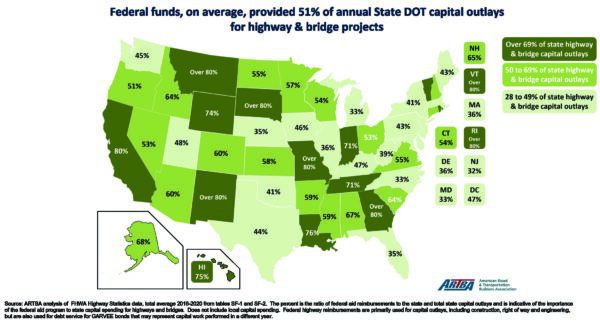
It is hard to overstate the role of the federal highway program to the development and continued management of the U.S. surface transportation network. As the map on the next page illustrates, federal funds, on average, support more than 50 percent of state highway and bridge capital outlays—with some states relying on the federal program for more than 80 percent.
The foundation of the federal-state partnership that is responsible for the nation’s network of highways and bridges are the formula programs, which provide state-focused, flexible, and recurring revenue. These different categories of federal support allow national needs to be pursued in a manner that respects the unique challenges and demands of each individual state.
Nearly nine out of every 10 dollars spent on highways and bridges under the IIJA will be directed via formula—$303 billion over five years.
Although Congress and the Biden administration did not finalize the 2022 appropriations process until about six months after the fiscal year’s Oct. 1 start, the states nevertheless worked quickly to commit the IIJA’s $53.5 billion in FY 2022 highway and bridge formula funds by the Sept. 30 deadline.
The 20 largest IIJA projects supported by formula funds in FY 2022 are:
- Texas – Expanding Loop 1604 on I-10 in San Antonio – $291 million
- Texas – 635 East Project in Dallas – $225 million
- New York –Van Wyck Expressway Capacity & Access Improvements to and from JFK International Airport – $211 million
- Arizona – Roadway Widening on I-17 Split – $200 million
- Texas – I-35 Widening in Travis County – $192 million
- South Carolina – Phase 1 Carolina Crossroads I-20/26/126 Corridor Improvement Project – $145 million
- Ohio – I-70/71 Downtown Ramp Up Project in Columbus – $123 million
- California – Rehabilitation of Pomona Freeway between the Long Beach and San Gabriel River Freeways – $121 million
- California – Route 46 Corridor Improvement Project in San Luis Obispo – $119 million
- Illinois – Interchange Reconstruction and Bridge Replacement on I-57 at I-74 Interchange in Urbana-Champaign – $107 million
- Georgia – State Road 2/State Road 515 Roadway Reconstruction Project in Northern Georgia – $104 million
- California – State Route 55 Improvements Project in Orange County – $101 million
- California – Rehabilitation of Route 10 Near Coachella – $100 million
- Tennessee – Interchange Modification on I-55 at Crump Boulevard in Memphis – $99.6 million
- Texas – Widen Loop 375 in El Paso – $95 million
- New Jersey – Route 18 Drainage and Pavement Rehabilitation in East Brunswick – $91.7 million
- Tennessee – Improvements at I-75, I-24 Interchange near the Tennessee-Georgia Border – $91.2 million
- South Carolina – Phase 2 Carolina Crossroads I-20/26/126 Corridor Improvement Project – $90 million
- California – SAC 5 Corridor Enhancement Project in Sacramento – $88 million
- Texas – Irving Interchange Project in Dallas – $80 million
State-Specific Impacts
The impacts of the 29,000 projects just launched will be widely felt—there is at least one new project in every congressional district.
The type of work ranges from major interstate capacity improvements to bundled bridge repairs in local communities. Here are examples of how these projects will positively impact both urban and rural communities.
- Delaware: Construction of a bypass between U.S. Highway 113 and SR 24 in Millsboro, will help improve safety and alleviate what is known as one of the worst bottlenecks in the state.[1] The new road will give trucks, including tractor-trailers, an alternate route instead of going through the downtown area.
- West Virginia: Work is underway on a dozen bridges that need rehabilitation or replacement on I-79. Smaller projects across the state are also providing key safety improvements. A project supported by IIJA investment was awarded this summer to upgrade guardrails on Corridor H in Hardy County.
- New York: Access to JFK International Airport will be the focus of a new $211 million project to improve capacity and access improvements on the Van Wyck Expressway.
ARTBA has provided committee members with two separate state-specific summaries throughout 2022, detailing how formula funds are being utilized. We will continue the practice of regular updates and also have available an online tool (artbahighwaydashboard.org) where IIJA information on state spending in support of highway and bridge projects can be accessed at your convenience.
Where the Formula Funds Are Directed
The type of improvements formula funds support will vary depending on projects selected by each state recipient. Critics of federal highway spending often misrepresent the programs’ work, suggesting these decisions are made in Washington, D.C., as opposed to in the communities that know first-hand how best to enhance mobility and safety.
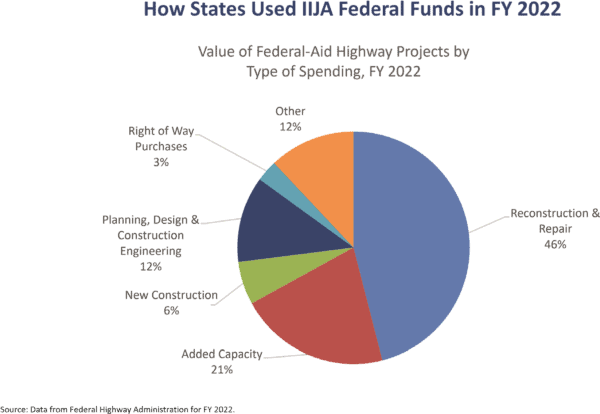
Annual data from the Federal Highway Administration (FHWA) illustrates the outcome of these decisions. The figure on the next page reinforces a long-standing trend of maintenance activities receiving the bulk of federal funds, with 46 percent of the value of projects supported by IIJA funds in FY 2022 going towards reconstruction and repair work.
States also used federal funds to support adding a lane or capacity to an existing right of way, accounting for 21 percent of project costs. New construction of a road or bridge that did not exist before accounted for six percent of total project costs.
Other spending (accounting for 12 percent of project costs) included projects related to bridge inspections, intelligent transportation systems, research, planning, and other eligible activities.
Discretionary Grants
The IIJA commits $45 billion over five years to highway and bridge allocated and discretionary grant programs designed to address numerous federal priorities, including: freight networks, infrastructure resiliency improvements, research, rural and mega projects and federal and tribal lands. About 13 percent of the IIJA’s highway and bridge funds will be distributed via these programs by the U.S. Department of Transportation (U.S. DOT).
Thus far, the Biden administration is awarding discretionary grant projects evenly between urban and rural areas.
For example, in FY 2022, U.S. DOT awarded, via the National Significant Freight and Highway Projects program, known as INFRA grants, 15 projects to rural communities and 11 to urban areas, though urban projects received a larger share of funding.
Similarly, the Local and Regional Project Assistance Program, known as RAISE grants, funding has been equally divided for the 166 projects between urban and rural areas. Roughly half of the awards went to road-related project improvements.
Though FY 2022 has concluded, about $3.4 billion in discretionary awards that could support highway and bridge improvements are outstanding, including the IIJA’s new Bridge Investment Program, National Infrastructure Project Assistance Program (MEGA), and Rural Surface Transportation Grant Program (RURAL).
IIJA Bridge Repairs: Work Underway, More to Come
The nation’s long-neglected bridges are also receiving significant attention because of the IIJA. ARTBA’s most recent analysis of the U.S. DOT’s National Bridge Inventory database found 43,578 structures are considered structurally deficient. With IIJA’s increased bridge discretionary grant program investment levels, combined with a new, dedicated bridge formula program, states are taking meaningful steps to address this challenge.
For example, Illinois committed $107 million for a project that includes an interstate bridge replacement in the central part of the state. States with a high number of rural bridges are using the law’s flexibility to bundle bridge projects, like in Alabama, to access funds and accelerate repairs.
The IIJA also created a new dedicated bridge formula program, but because those funds have four years to be committed to projects, most states did not obligate funds in the first year, opting to leverage other formula programs for bridge work. However, several states have already begun to take advantage of this opportunity. For example, Pennsylvania used bridge formula funds to support 129 projects in year one. The Biden administration announced a series of small bridge planning grants in October, but the vast majority of the $2.4 billion in Bridge Investment Program grants have not been awarded.
Inflation’s Impact on the Bipartisan Infrastructure Law
There are few public sector actions that can deliver the same level of short- and long-term economic benefits as transportation infrastructure investment. Increased construction activity provides immediate job creation and retention, while putting in place capital assets that support supply chain improvements and enable access to jobs, services, materials, and markets for decades. These dual-track benefits are particularly critical during times of economic uncertainty and disruptions, like those we have faced since the onset of the COVID-19 pandemic.
These adverse economic conditions must factor into any analysis of the IIJA’s first year. Increased materials costs—and decreased availability or extended delivery times in many cases—have undoubtedly had a dilutive impact on the new law’s historic investment levels.
Since the pandemic, high inflation rates have challenged nearly all sectors of the economy, and ARTBA’s tracking of the costs for highway and street construction inputs, like energy, goods and services, show increases of almost 30 percent since January of 2021 and 11 percent since the IIJA’s enactment. Estimates of total project cost inflation, which also accounts for labor, overhead and other less volatile inputs, are not as extreme but still significantly elevated over historical growth rates.
This national data underscores the challenging environment in which the new infrastructure law’s first year of investments are being deployed. This information, however, must also be considered alongside the wide variances that are occurring among states, regions, and project types.
While we have received reports of input cost increases in excess of 40 percent for some commodities, as well as difficulties in procuring key materials, we also have seen a significant number of states in which project bids continue to come in below the initial engineer’s estimates. Furthermore, 32 states have increased the value and number of contract awards for highway and bridge improvements over the last year.
The dilutive impact of inflation on highway and bridge investment underpins ARTBA’s calls for U.S. DOT to adopt a consistent and pragmatic policy regarding price escalation clauses. As part of this dialogue, we have urged the agency to modernize its practices and allow federal funds to be used for price escalation clauses on contracts pre-dating the bulk of COVID-induced economic disruption. The unprecedented and unforeseen increase in costs our industry has experienced in the last two years warrant enhanced flexibility in the use of these funds to preserve the continuity and efficacy of these projects.
Ultimately, though, as challenging as this situation has been for states and the transportation construction industry, ARTBA interprets the combination of available data as pointing to real— albeit heavily muted—market growth over the last year. Without the infrastructure law this committee helped craft, we would likely be looking at a market contraction.
Other IIJA Opportunities & Impediments
The funding increases in the infrastructure law are critical to delivering real-world safety and economic benefits. However, the bipartisan policy reforms in the IIJA also deserve attention since their implementation has the potential to speed up or slow down the law’s outcomes. These reforms are some of the most substantial changes to federal surface transportation policy in more than a decade, but their uneven implementation warrants scrutiny.
One Federal Decision
The IIJA’s project delivery process reforms, known as “One Federal Decision,” were a shining example of the law’s bipartisan spirit. However, in the year since its enactment, little progress in implementing them has been apparent. The current environmental review process takes an average of five to seven years to complete for a new federal-aid transportation project.[2] In some cases, ARTBA members have even experienced projects taking up to 14 years for review. These delays come at significant cost to taxpayers.
One Federal Decision seeks to alleviate some of these costs by moving projects from the study phase to construction more quickly without sacrificing important environmental safeguards.
In September, the FHWA published interim guidance concerning the IIJA’s project delivery provisions but noted its contents do “not have the force and effect of law and are not meant to bind the States or the public in any way.”[3] At the same time, the White House Council of Environmental Quality (CEQ) is currently rolling back recent National Environmental Policy Act (NEPA) reforms designed to reduce project delays. Reversing these improvements undermines the goal of saving time through streamlined project reviews and reinstates a NEPA process which often features excessive litigation over projects and procedural minutiae.
In 2023, the U.S. DOT is scheduled to submit a report to Congress on the efficiencies of the environmental review process and impediments to reaching the IIJA’s project delivery goals.[4] The agency should prioritize the implementation of these overdue reforms to ensure they have an opportunity to be utilized before their impacts are the subject of such a report. The IIJA’s success will be judged by delivering infrastructure improvements to communities in a timely and cost-effective manner. A workable review process is integral to meeting this objective.
We appreciate the committee’s oversight to date of the bipartisan infrastructure law’s implementation and urge you to remain engaged in the months ahead.
Buy America
The “Build America, Buy America Act,” embedded in the IIJA, has emerged as a significant implementation challenge in its early months. ARTBA recognizes and supports the clear congressional intent to grow domestic manufacturing capacity in the long-term. Our concern relates to the potential for short-term disruptions of projects emanating from the IIJA’s new requirements in this area.
For more than 40 years, Buy America has required that a domestic manufacturing process for iron, steel and certain manufactured products be permanently incorporated into federal-aid highway and transit projects. The IIJA expanded Buy America coverage to five categories of construction materials (non-ferrous metals, plastic and polymer-based products, glass, lumber, and drywall). After U.S. DOT deferred this new requirement for six months, it took effect November 10. At the same time, the department proposed narrow waivers from Buy America for items falling under modest de minimis thresholds and for the smallest of federal-aid projects. It proposed waiving the construction materials requirement for projects in advanced stages of procurement or for which contracts were already in place.
These waivers, while responsive to issues ARTBA has raised during this rulemaking stage, leave unanswered questions, all of which underscore our concerns about disrupting IIJA-funded projects. These include:
- Lack of a centralized, national effort to assess the domestically made availability of products falling under the five categories of construction materials listed above.
- Dearth of clear guidance on the new requirements, to ensure consistent implementation by all FHWA division offices, FTA regional offices and state and local transportation agencies.
- Continued potential for significant administrative costs and delays if contractors must document the origin of small, inexpensive commercially-available off-the-shelf (COTS) products that exceed the proposed de minimis thresholds.
- Ambiguities in the waiver process specific to particular projects and products.
We urge this committee to engage with the Office of Management and Budget’s Made in America Office, which is overseeing all domestic preference programs and evaluating all proposed waivers, and U.S. DOT to seek clarity in these areas. The new law’s robust investment levels should enhance opportunities in domestic manufacturing, as is the intent of Congress. However, disrupting projects based on unclear (or unrealistic), short-term domestic preference objectives would undercut the economic benefits Congress intended, while doing little to advance the purpose of “Build America, Buy America” itself.
IIJA Year-One Takeaways
The key takeaway from the first year of the IIJA is that the law is working as intended, with state transportation departments disbursing their funds and projects breaking ground in communities across America.
A virtue of the multi-year surface transportation reauthorization is the economic benefits that will follow project completion—be it increased state and local tax revenue, local job creation, or a boost to household income—are only set to compound from where we are today.
ARTBA members remain committed to working in partnership with state transportation agencies to realize the full vision of the IIJA.
Thank you again for the opportunity to testify. We look forward to sharing IIJA project success stories in the coming years.
Related Resources
Congressional Testimony: Restoring Common Sense to NEPA Reviews
Testimony Presented to the House Committee on Natural Resources Anthony P. Boals, P.E.,…
Congressional Testimony: Examining the U.S. Department of Transportation’s Regulatory and Administrative Agenda
Testimony Presented to the House Subcommittee on Highways & Transit Tim Duit, President,…
Congressional Testimony: IIJA Implementation
ARTBA Chair Paula Hammond’s (WSP USA) testimony before the U.S. House Highways & Transit Subcommittee.