
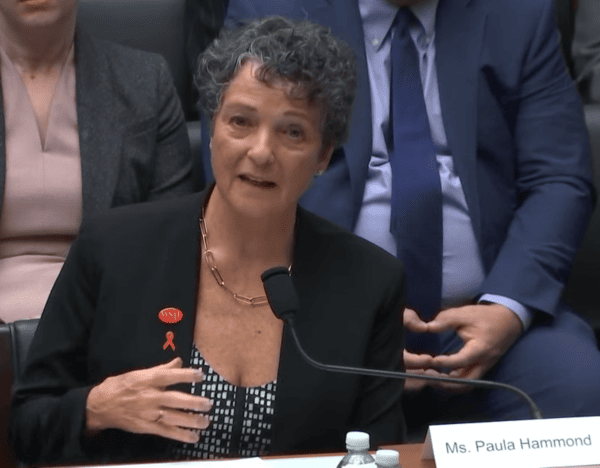
Testimony Presented to the House T&I Subcommittee on Highways & Transit
Paula Hammond, SVP & National Market Leader, WSP USA, 2023 ARTBA Chair
Subcommittee Chairman Crawford, Ranking Member Norton, and members of the subcommittee, thank you for convening today’s hearing. I am Paula Hammond, a senior vice president with WSP USA, a global engineering and design firm. I also serve as the current chair of the American Road & Transportation Builders Association (ARTBA).
Established in 1902, ARTBA is the only national association representing all aspects of the U.S. transportation design and construction community. Our 8,000 members and 36 state affiliates own, manage, design, build and provide equipment and materials for all modes of transportation infrastructure improvements. The transportation construction industry generates $580 billion annually in U.S. economic activity and sustains more than four million jobs.
ARTBA has long advocated for federal leadership in the development and maintenance of a national transportation network to support continued U.S. economic growth and meet the public’s demand for safe and efficient travel.
The Infrastructure Investment and Jobs Act (IIJA) provides a much-needed boost over the next five years to help support the modernization of the nation’s multi-modal transportation network.
With year two under way, the law’s enhancements are becoming more apparent. From contract awards to construction activity, key market indicators across the project pipeline identify the initial benefits of federal highway investment, despite continued inflation and lingering supply chain issues.
Today’s hearing offers an opportunity to highlight the law’s successes, while acknowledging the challenges that remain.
Driving State Improvements
Nearly half of the IIJA’s generational investment—$450 billion—will be spent improving highways, bridges and public transportation systems. The IIJA represents the largest nominal increase in highway funding in 65 years.
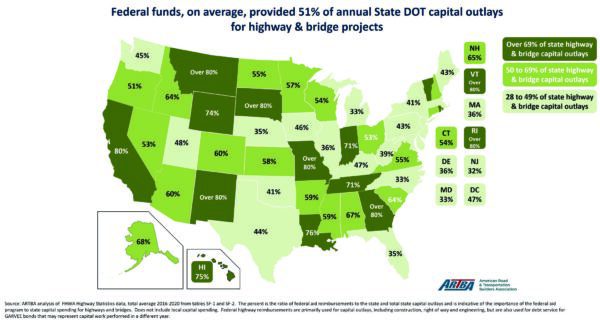
The law’s success will be built on the strong partnership between the federal government and states. As the map below illustrates, federal investment supports more than 50 percent of the average state’s capital outlays, with some states relying on federal funds for more than 80 percent.
The foundation of the federal-state partnership are the formula programs. Nearly nine out of every 10 dollars spent on highways and bridges are directed via formula programs, which provide state-focused, recurring revenue for priorities like the National Highway Performance Program, the Bridge Investment Program, and the Highway Safety Improvement Program. These programs facilitate the pursuit of national needs in a manner that respects state flexibility in project selection.
The formula programs create state funding certainty, which drives growth in state transportation budgets. State highway and bridge capital outlays are expected to increase 16 percent in Fiscal Year (FY) 2023, according to an ARTBA analysis of all 50 state transportation budgets. This spending reflects planned construction activity and reimbursements for ongoing state and federal-aid highway projects. Over 70 percent of the expected growth in state DOT budgets in FY 2023 will come from federal reimbursements to state transportation authorities.
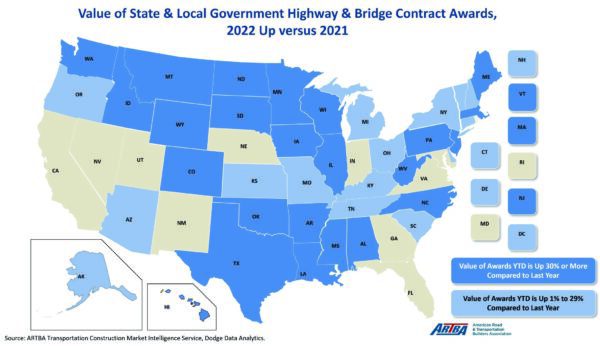
Further, 37 states saw an increase in the value and number of contract awards for highway and bridge improvements over the last year. The value of state and local government highway and bridge contract awards jumped 25 percent in 2022, as agencies increased the number of projects by 4,280.
The chart below highlights states that have increased the value of highway and bridge contract awards, reflecting IIJA, state, and local funds.
Projects Advanced Nationwide
Congress did not finalize the 2022 appropriations process until about six months after the fiscal year’s Oct. 1 start, and four-and-a-half months after IIJA’s enactment. States nevertheless were able to commit year-one’s $53.5 billion in highway formula funds to thousands of projects by the Sept. 30 deadline.
Congress avoided a similar situation in FY 2023 by completing the appropriations process in December, thereby affording states 10 months of funding certainty. Accordingly, ARTBA’s analysis of U.S. Treasury data shows, in the first four months of FY 2022, states committed $3.4 billion in funds, compared with $7.2 billion in funds over the same time for FY 2023. This increase represents 3,000 more new projects compared with the first few months of the IIJA.
Taken together, in the first 16 months of the IIJA, states committed funds to nearly 36,400 new projects, totaling $61.3 billion in formula and discretionary funds through Jan. 30, 2023. These new projects stretch from coast to coast, with at least one new project underway in every congressional district.
Formula programs allow states flexibility to choose the type of work that best suits their needs. Some states are prioritizing major Interstate capacity improvements, while others may bundle bridge repairs to address maintenance backlogs. Here is a sample of how states are using formula funds to positively impact urban and rural communities.
- In Arkansas’ first district, a nearly $40 million project is underway to repair and rehabilitate a section of Highway 148.
- Missouri’s Nodaway and Andrew counties in the sixth district congressional district will see $11 million in the rehabilitation of Highway 71.
- Washington, D.C. will be using $16 million in formula funds to conduct maintenance on tunnel infrastructure in the district.
- The state of Washington began $34 million worth of work on two bridges over the Snohomish River in the second district.
The IIJA’s long-term funding certainty is helping states to move forward on large projects. The number of large projects receiving federal support of $50 million or more increased by over 50 percent in FY 2022. In total, 105 projects across 29 states saw $50 million+ in federal investment compared to just 69 projects in 25 states in FY 2021.
The table below highlights the top projects receiving formula funds during the first 16 months of the IIJA.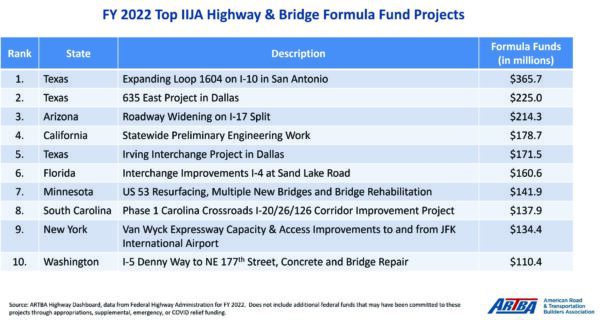
How Formula Funds Are Directed
ARTBA uses data from a range of federal sources to track how formula funds are being spent. We have made this data available via www.artbahighwaydashboard.org to illustrate projects by state and congressional district. All subcommittee member offices have received a copy of their district’s information.
The data also allows us to track the types of projects formula funds are supporting. The figure below depicts the breakdown of highway project investments in FY 2022.
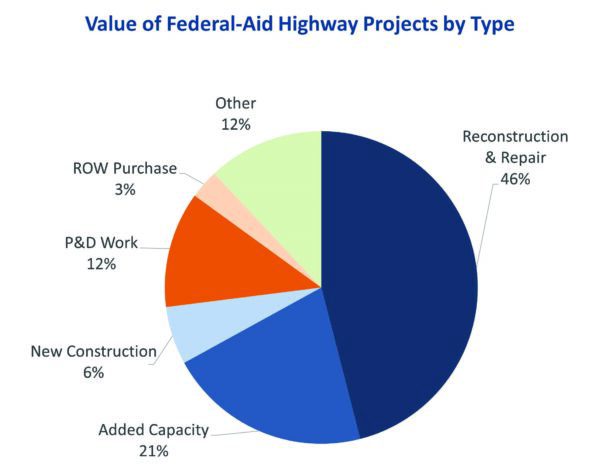
States are prioritizing maintenance activities, which received nearly half of federal funds. Adding capacity to an existing right-of-way is the second largest recipient of funds at 21 percent. Construction of a road or bridge that did not exist before accounted for six percent of total project costs
Other spending (accounting for 12 percent of project costs) included projects related to bridge inspections, intelligent transportation systems, research, planning, and other eligible activities.
The advantage of formula programs is that most project selection decisions are made by those who know first-hand how best to improve mobility and safety in their communities—the states.
Project Profile: The Chester Bridge, Perryville, Mo.
Committing federal funds to projects is typically step one of a multi-year process to see a project through to completion. The Chester Bridge project in Missouri illustrates the process of federal support from initial commitment through completion and reimbursement.
The bridge spans the Mississippi River and connects Perryville, Missouri, and Chester, Illinois. The 2,827-foot bridge was originally constructed in 1942 and is in “poor” condition, according to the 2022 National Bridge Inventory. The bridge sees more than 7,000 vehicle-crossing per day.
In FY 2022, Missouri committed over $107 million in IIJA formula funds towards the design-build project. The Missouri Department of Transportation (MoDOT) issued a request for qualifications in June 2022 and followed up that month with industry and community briefings. The request for proposals was released in September 2022 and the contractor team was selected in March 2023.
Ames Construction Inc. and Parsons Transportation Group were awarded the $284 million contract to construct the three-tower, cable-stayed bridge. Work will get underway on the bridge this year and with expected completion in 2026.
As construction work is completed, MoDOT will reimburse the construction team and will in turn be reimbursed by the U.S. Treasury for the federal portion of the project.
Transit System Improvements Underway
Enhancements to transit systems are taking place throughout the country thanks to the Capital Investment Grants (CIG) program, which funds major capital improvements to expansion and core capacity projects. Types of projects receiving 2023 CIG awards include:
- New 10-mile bus rapid transit line in St. Paul, Minn.
- 13-mile bus rapid transit project in Las Vegas, Nev.
- Phase 2 of Second Avenue Subway in New York City.
Discretionary Grants Supplement Formula Work
The IIJA commits $45 billion over five years to supplemental and discretionary grant programs designed to address freight networks, promote resiliency, and provide focused support to rural and mega projects. About 13 percent of the IIJA’s funds will be distributed via these programs by the U.S. Department of Transportation (U.S. DOT).
To date, the Biden administration has awarded projects evenly between urban and rural areas.
For example, National Significant Freight and Highway Projects, known as INFRA grants, were awarded for FY 2022 with 15 projects to rural communities and 11 to urban areas, though urban projects received a larger share of funding.
Similarly, the Local and Regional Project Assistance Program, known as RAISE grants, equally divided funding for the 166 projects between urban and rural areas. Roughly half of the awards went to roadrelated project improvements.
Nearly all FY 2022 grants have been awarded, however grants to fund charging infrastructure, resiliency projects, and smaller bridge projects are still outstanding, even though we are approaching the midpoint of FY 2023.
Making Headway on Deficient Bridges
The Fern Hollow Bridge in Pittsburgh became a front-page story when it collapsed in January 2022, shortly after the IIJA was signed into law. Thanks to federal transportation investment, including the IIJA, the Fern Hollow Bridge is a success story. It was rebuilt and reopened in less than a year.
The law’s dedicated bridge formula program will empower states to begin addressing the more than
223,000 bridges in need of repair or rehabilitation, according to ARTBA’s most recent analysis of U.S. DOT’s National Bridge Inventory database. Nearly 43,000 bridges are classified as structurally deficient or in poor condition, and the IIJA’s investments will help ensure states take meaningful action to repair them.
Major bridge discretionary grant awards often draw headlines, but bridge projects large and small are advancing across the country. For example, in Illinois, $107 million was dedicated to a project that includes an interstate bridge replacement in the central part of the state. Pennsylvania used formula dollars to commit to 129 bridge improvements in year-one of the IIJA.
Some states with a high number of rural bridges are using the law’s flexibility to bundle bridge projects, like in Alabama and Oklahoma, to access funds and accelerate repairs.
Amid Progress, Challenges Remain
Funding increases in the infrastructure law are yielding real world improvements in communities across the country. However, the reforms included some of the most significant changes to federal surface transportation policy in over a decade, and if implemented properly, have potential to speed up project delivery.
Impact of Inflation
There are few public sector actions that can deliver the same level of short- and long-term economic benefits as transportation infrastructure investment. Increased construction activity provides immediate job creation and retention, while putting in place capital assets that support supply chain improvements and enable access to jobs, services, materials, and markets for decades. These dual-track benefits are particularly critical during times of economic uncertainty and disruptions.
Recent adverse economic conditions cannot be separated from an analysis of the IIJA’s first year. Increased materials costs – and decreased availability or extended delivery times in many cases—have undoubtedly had a dilutive impact on the new law’s historic investment levels.
ARTBA’s tracking of the costs for highway and street construction inputs, like energy, goods and services, show increases of almost 30 percent since January of 2021 and 11 percent since the IIJA’s enactment. Estimates of total project cost inflation, which also accounts for labor, overhead and other less volatile inputs, are not as extreme but still significantly elevated over historical growth rates.
The chart below illustrates the monthly increase in highway and street construction goods since 2014. Cost increases began around the onset of the pandemic and picked up significantly in 2021. Though some signs of easing have occurred recently, prices are still elevated and volatile.
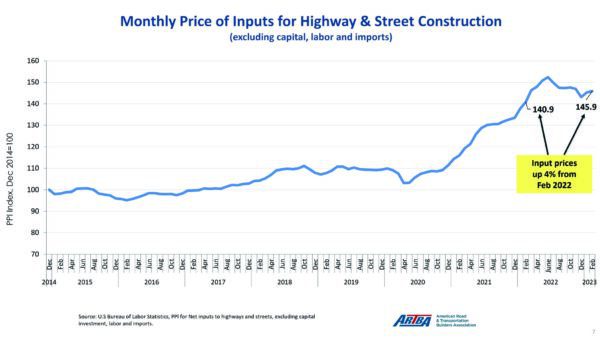
This national data underscores the challenging environment in which the infrastructure law’s investments are being deployed. However, there is variance among states, regions and project types. We have received reports of input cost increases of more than 40 percent for some commodities, along with difficulties in procuring key materials. At the same time, we have seen a significant number of states in which project bids continue to come in below the initial engineer’s estimates.
The dilutive impact of inflation on highway and bridge investment underpins ARTBA’s repeated urgings that the U.S. DOT adopt a consistent and pragmatic policy regarding price escalation clauses. As part of this dialogue, we have urged the Federal Highway Administration (FHWA) to modernize its practices and allow federal funds to be used for price escalation clauses on contracts pre-dating the bulk of COVID-induced economic disruption. The unprecedented and unforeseen increase in costs our industry has experienced in the last two years warrants enhanced flexibility in the use of these funds to preserve the continuity and efficacy of these projects.
Ultimately, though, as challenging as this situation has been for states and the transportation construction industry, ARTBA interprets the combination of available data as pointing to real market growth over the last year.
Furthermore, any discussion about materials prices and inflation needs to also recognize that, without the infrastructure law, we would very likely be looking at a market contraction.
Awaiting Project Delivery Implementation
The IIJA featured project delivery reforms, known as “One Federal Decision,” which exemplified a bipartisan spirit. The current environmental review process takes an average of five to seven years to complete for a new federal-aid transportation project[1], and in some cases, ARTBA members have even experienced projects taking up to 14 years for review. These delays come at significant cost to taxpayers and illustrate the need for reform. However, in the time since IIJA’s enactment, there has been little visible progress.
One Federal Decision seeks to alleviate costs associated with project delays by setting a two-year goal for project reviews and moving projects from the study phase to construction more quickly, without sacrificing important environmental safeguards.
At the same time, the White House Council of Environmental Quality (CEQ) is currently rolling back recent National Environmental Policy Act (NEPA) reforms designed to reduce project delays. Reversing these improvements undermines the goal of saving time through streamlined project reviews and reinstates a NEPA process which often features excessive litigation over projects and procedural minutiae.
Later this year, the U.S. DOT is scheduled to submit a report to Congress on the efficiencies of the environmental review process and impediments to reaching the IIJA’s project delivery goals[2]. The agency should prioritize the implementation of these overdue reforms to ensure they have an opportunity to be utilized before their impacts are the subject of such a report. The IIJA’s success will be judged, in part, by delivering infrastructure improvements to communities in a timely and cost-effective manner. A workable review process is integral to meeting this objective.
We appreciate the committee’s oversight to date of the infrastructure law’s implementation and urge you to remain vigilant in the months ahead.
Build America, Buy America
The “Build America, Buy America Act” (BABA), embedded in the IIJA, remains a significant implementation challenge. ARTBA supports the clear congressional intent to grow domestic manufacturing capacity in the long-term. Our concern relates to the potential for short-term disruptions of projects emanating from the IIJA’s new requirements in this area.
For more than 40 years, Buy America has required a domestic manufacturing process for iron, steel and certain manufactured products permanently incorporated into federal-aid highway and transit projects. The IIJA expanded Buy America coverage to five categories of construction materials (non-ferrous metals, plastic and polymer-based products, glass, lumber, and drywall).
After U.S. DOT deferred this new requirement for six months, it took effect on November 10, 2022. At the same time, the department proposed narrow waivers from Buy America requirements for items falling under modest de minimis thresholds and for the smallest of federal-aid projects. It also proposed (and finalized on Jan. 30) a waiver of the construction materials requirement for projects in advanced stages of procurement or for which contracts were already in place.
More than 16 months following the IIJA’s enactment, many of the parameters for Buy America implementation remain unsettled, underscoring our concerns about potential disruption of projects. Specifically:
- The Office of Management and Budget (OMB) has yet to complete guidance on the new requirements, to ensure consistent implementation by all FHWA division offices, Federal Transit Administration (FTA) regional offices and state and local transportation agencies.
- OMB is considering extending Buy America coverage to items, including aggregates and other paving materials, which Congress explicitly exempted in the IIJA.
- The de minimis waiver described above is still pending after more than four months.
- There is still no centralized, national effort to assess the domestically-made availability of products falling under the five categories of construction materials in the law.
- FHWA is now reviewing its longstanding waiver for manufactured products. Rolling back this waiver will result in significant administrative costs and delays, in part because contractors will need to document the origin of small, inexpensive commercially-available off-the-shelf (COTS) products that exceed the proposed de minimis thresholds.
We urge this committee to engage with OMB’s Made in America Office, which is overseeing all domestic preference programs and evaluating all proposed waivers, to seek clarity in these areas. Moreover, U.S. DOT brings more than four decades of experience implementing Buy America. OMB should incorporate that expertise into this effort, rather than imposing unrealistic policies that are beyond the scope of BABA and could undercut the IIJA’s investments with project cost increases and delays.
Safety
The March 22 tragedy on I-695 in Baltimore is a heartbreaking reminder of the risks facing men and women employed on roadway construction sites. The lives of six roadway workers were lost when a vehicle crashed into an active construction site.
Approximately 850 fatalities occur in and around these sites annually, and as many as 200 are roadway workers. Ensuring a safe workplace for the thousands of men and women tasked with building mobility and safety enhancements provided by the IIJA is ARTBA’s top priority.
As the IIJA supports thousands of new projects, there will also be an increased number of work zones, resulting in increased risk exposure for workers. The transportation construction community is committed to doing its part to mitigate an increase in the number of safety-related incidents.
The health and well-being of workers who build, maintain, and renovate transportation systems are not always fully considered by those who depend on them to create a safe system. FHWA discusses ways to enhance pedestrian safety for “vulnerable road users,” but additional emphasis on protecting workers is critically necessary.
Previous law requires the use of positive protection in certain high-risk work zones, and we urge that Title 23’s Subparts J and K regulations be updated in accordance with the Moving Ahead for Progress in the 21st Century (MAP-21) reauthorization law that required additional considerations for use of positive separation. It also incorporated provisions to allow greater enforcement and/or consequences for those who do not follow the law.
We also call on FHWA to require positive separation considerations and suppositions in the forthcoming Manual on Uniform Traffic Control Devices (MUTCD).
Looking Ahead
The key takeaway from the 16 months of the IIJA is that its highway and bridge funding provisions are working as intended, with state transportation departments breaking ground on improvement projects in communities across America.
A virtue of the multi-year surface transportation reauthorization is the economic benefits that will follow project completion—be it increased state and local tax revenue, local job creation, or a boost to household income—are only set to compound from where we are today.
ARTBA members remain committed to working in partnership with state transportation agencies to maximize IIJA’s transportation improvements.
We will continue to provide members of Congress with regular IIJA updates. The association has also recently created a new resource (www.transpoinfo.org) that provides macro-level insights on the role transportation plays in every congressional district, detailing the scope of the transportation network, economic and safety data, and commute times. We trust you will use this tool to track improvements in your district as the law progresses.
ARTBA appreciates the opportunity to testify before the subcommittee and will continue its efforts to share the project success stories of the IIJA in the coming years.
[1] Executive Office of the President, Council on Environmental Quality, Environmental Impact Statement Timelines (2010-2018), available at https://ceq.doe.gov/docs/nepa-practice/CEQ_EIS_Timeline_Report_2020-6-12.pdf, p. 10.
[2] Sec. 11301, Codification of One Federal Decision.
Related Resources
Congressional Testimony: Restoring Common Sense to NEPA Reviews
Testimony Presented to the House Committee on Natural Resources Anthony P. Boals, P.E.,…
Congressional Testimony: Examining the U.S. Department of Transportation’s Regulatory and Administrative Agenda
Testimony Presented to the House Subcommittee on Highways & Transit Tim Duit, President,…
Putting the Bipartisan Infrastructure Law to Work: The Private Sector Perspective
ARTBA President Dave Bauer’s testimony before the U.S. Senate Environment & Public Works Committee.